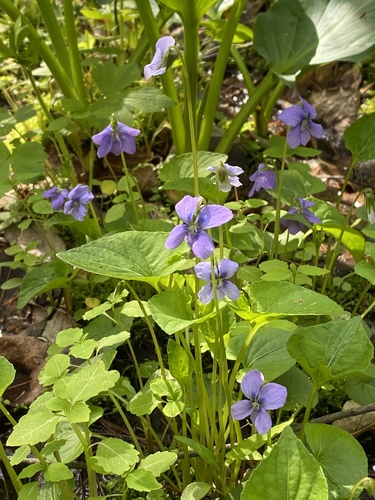
marsh blue violet
Viola cucullata
A vibrant herald of spring, the marsh blue violet transforms soggy garden corners into a sea of deep purple. This 'hooded' beauty isn't just a treat for the eyes—it's a vital sanctuary for rare butterflies and early-season bees.
Quick Identification
Size
6-10 inches (15-25 cm) tall with a similar spread
Colors
Deep violet to sky blue petals with white centers; dark purple veins on the lower petals; bright green heart-shaped leaves
Key Features
- Heart-shaped leaves with edges that roll inward at the base (hooded appearance)
- Flowers held on stalks significantly taller than the leaves
- Lower three petals feature prominent dark purple nectar guides
- Side petals are usually hairless or 'beardless' compared to other violets
When You’ll See Them
Behavior
The marsh blue violet is a perennial wildflower that serves as a cornerstone of early spring ecosystems. Unlike many other violets that hug the ground, this species stands tall on slender stalks to ensure its blooms are visible to passing pollinators. It is particularly known for its 'cleistogamous' flowers—small, bud-like flowers near the base of the plant that never open but self-pollinate to ensure seed production even if spring weather is too poor for insect activity.
In the backyard, these plants are more than just pretty faces; they are the primary host plant for several species of Fritillary butterflies. The larvae of these butterflies depend entirely on violet leaves for food. While they are docile residents of wet areas, they are competitive enough to form dense, beautiful mats if the soil conditions are right, providing excellent ground cover for small amphibians and insects.
EverydayEarth exclusive
Camera Tips
To capture the stunning detail of a marsh blue violet, you need to get low. These plants rarely exceed ten inches in height, so mounting your camera on a ground-level spike or using a 'beanbag' mount is essential. Aim for a side-on profile rather than a top-down shot; this allows you to see the unique 'hooded' shape of the leaves and the way the flower stalks rise above the foliage, which is a key identifying trait of this species.
Because these violets thrive in wet, boggy soil, camera protection is your first priority. Use a waterproof housing or place your camera on a small elevated platform to prevent it from sinking into the mud or being damaged by rising water after a spring rain. If you are using an AI-powered trail camera, set it to 'Macro' mode if available, or position the lens roughly 12 to 18 inches away from a healthy cluster of blooms to ensure the delicate purple veins (nectar guides) are in sharp focus.
Time-lapse is an incredible way to document this species. Set your camera to take a photo every 15 minutes during the daylight hours in late April. You will be able to see the flowers track the sun and observe the rapid growth of the seed pods. Additionally, these flowers are magnets for Great Spangled Fritillary butterflies; by focusing your camera on a specific clump, you have a high probability of capturing high-quality insect action that many standard 'wildlife' setups miss.
Lighting is the final secret. The deep blues and purples of the marsh blue violet can easily look 'blown out' or muddy in direct, harsh midday sun. The best images are captured during the 'golden hours' of early morning or late afternoon, or even on a slightly overcast day. The soft, diffused light of a cloudy sky brings out the saturation of the petals and prevents the waxy leaves from creating distracting glares.
Similar Species
Species that look similar or are commonly confused with marsh blue violet.
Frequently Asked Questions
Record marsh blue violet at your habitat
Connect a camera to start building your own species record — AI identifies every visitor automatically.