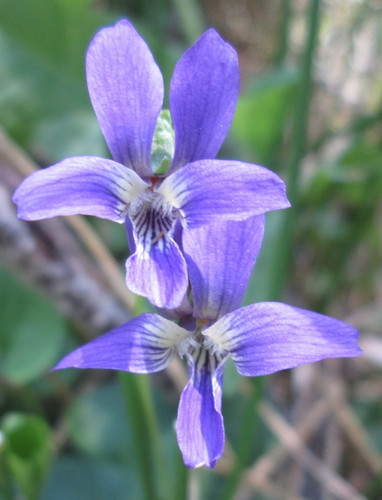
northern bog violet
Viola nephrophylla
A splash of royal purple in the dampest corners of the wild, the northern bog violet is a resilient gem of the wetlands. Watch as these kidney-leaved beauties transform soggy soil into a vibrant spring tapestry.
Quick Identification
Size
Height typically ranges from 5 to 25 cm (2 to 10 inches); leaves 2 to 7 cm (1 to 3 inches) wide.
Colors
Deep purple to blue-violet petals with a contrasting white throat; bright green kidney-shaped leaves.
Key Features
- Distinctive kidney-shaped to heart-shaped leaves
- Deep violet flowers with white centers and fine dark veining
- Smooth, hairless stems and foliage
- Typically found in very wet, saturated soils
When You’ll See Them
Behavior
The northern bog violet is a charming perennial that signals the arrival of spring in damp, cool environments. Unlike many of its cousins that prefer dry woodland floors, this species thrives where its 'feet' are wet, often found nestled among mosses or near the edges of slow-moving streams. It plays a vital role in the early season ecosystem, providing an essential nectar source for emerging bees and butterflies.
As the season progresses, the plant produces two types of flowers. The showy purple ones we see in spring are for cross-pollination. Later in the summer, it develops 'cleistogamous' flowers—small, bud-like blooms that never open and self-pollinate under the leaves. This dual strategy ensures the plant's survival even if pollinators are scarce. In a backyard setting, they are quiet residents, spreading slowly via underground rhizomes to form lush, green carpets in shady, moist corners.
EverydayEarth exclusive
Camera Tips
Capturing the northern bog violet requires a different approach than fast-moving wildlife. To get the best shots, mount your camera on a low-profile ground spike or a mini-tripod just 3-5 inches off the ground. Angling the lens slightly upward will capture the intricate details of the flower's 'throat' and the delicate veining on the petals. Because these violets grow in wet areas, ensure your camera housing is waterproofed or placed on a dry patch of moss to prevent moisture damage.
If your camera has a time-lapse mode, this is the perfect species for it. Set the interval to capture a frame every 15-30 minutes during the peak blooming weeks of May. This will allow you to see the flowers track the sun and watch the buds unfurl into full blooms. For the most vibrant colors, avoid the harsh midday sun which can wash out the deep purples; instead, focus on the 'golden hours' of early morning or late afternoon when the soft light emphasizes the velvet texture of the petals.
While you don't need traditional bait, you can attract 'action' to the plant by ensuring the soil remains moist, which may draw in pollinators like the Fritillary butterfly. Setting your camera to a macro or close-focus setting is essential, as the fine details of the spurred petals are the star of the show. If your backyard camera has a PIR (Passive Infrared) sensor, it might not trigger on a plant, so use 'Time-Lapse' or 'Hybrid' mode to ensure you get consistent captures regardless of movement.
Lastly, consider the background. Clear away any dead brown grass or distracting twigs from the immediate vicinity of the plant to make the vibrant green leaves and purple flowers pop. If you are using an AI-powered camera like those supported by EverydayEarth, the high contrast between the purple petals and green foliage makes for excellent identification triggers even in dappled forest light.
Similar Species
Species that look similar or are commonly confused with northern bog violet.
Frequently Asked Questions
Record northern bog violet at your habitat
Connect a camera to start building your own species record — AI identifies every visitor automatically.