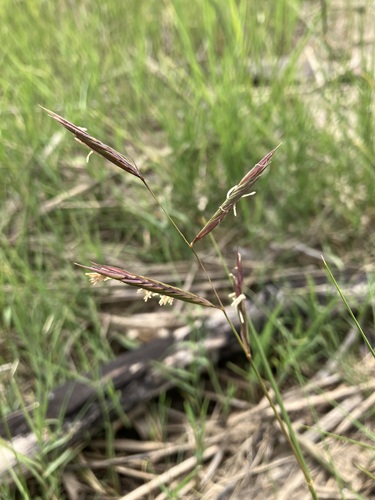
Marsh Hay Cordgrass
Sporobolus pumilus
The swaying 'salt hay' of the Atlantic coast, Marsh Hay Cordgrass creates a shimmering green and gold carpet across our marshes. Known for its iconic swirling 'cowlicks,' it provides a hidden sanctuary for some of the coast's most elusive wildlife.
Quick Identification
Size
12-36 inches (30-90 cm) tall; leaves are very slender, usually less than 0.1 inches (3 mm) wide.
Colors
Bright green during the growing season; fades to a distinctive golden-tan or bronze in autumn and winter.
Key Features
- Slender, wiry leaves that roll inward to look like needles
- Growth habit creates swirling 'cowlicks' or flat mats
- Thrives in the 'high marsh' zone above the daily high tide
- Flower spikes appear on only one side of the stalk
When You’ll See Them
Behavior
Marsh Hay Cordgrass is a resilient perennial that defines the visual landscape of the high salt marsh. Unlike its taller cousin, Smooth Cordgrass, which stands upright in the mud, Marsh Hay Cordgrass has flexible, wiry stems. When the wind blows across a meadow of this species, the stems break at the base and lean over, creating swirling, circular patterns often called 'cowlicks.' These dense, matted layers are more than just a beautiful sight; they create a complex microhabitat that stays cool and moist even in the summer heat.
This grass is a master of salt management. It lives in areas where the soil is salty but not submerged daily. It effectively filters salt through its roots and can even excrete excess salt through specialized glands on its leaves. For humans, it has a long history of utility; early settlers harvested it as 'salt hay' for livestock bedding and insulation, a practice that continues on a smaller scale today in some coastal communities.
EverydayEarth exclusive
Camera Tips
Capturing the beauty of Marsh Hay Cordgrass requires a strategy for managing motion. Because these thin blades are incredibly lightweight, they sway in the slightest coastal breeze. If you are using an AI-powered camera, this constant movement can lead to 'false triggers.' To combat this, we recommend setting your camera to 'Low' motion sensitivity or utilizing 'Detection Zones' to focus on a stable area like a nearby log or a specific bird-nesting site within the grass.
For the most iconic shots, go low. Place your camera just 6 to 10 inches above the ground, angled slightly upward. This 'vole-eye view' emphasizes the swirling 'cowlick' texture of the mats and is the best way to catch footage of the secretive wildlife that lives under the canopy, such as Saltmarsh Sparrows or the Meadow Vole. A low angle also allows the camera to catch the sun as it filters through the wiry blades, creating a glowing effect.
Timing is critical for this species. Use the 'Golden Hour'—the hour after sunrise or before sunset. The backlighting during these times turns a field of Marsh Hay Cordgrass into a shimmering sea of gold. If your camera has a time-lapse feature, a 24-hour cycle can beautifully document the way the grass flattens and rises with the wind and the moisture levels of the tide. In the winter, keep the camera active; the golden-tan color of the dead stalks provides a stunning, high-contrast background for spotting wintering birds or foxes.
Similar Species
Species that look similar or are commonly confused with Marsh Hay Cordgrass.
Frequently Asked Questions
Record Marsh Hay Cordgrass at your habitat
Connect a camera to start building your own species record — AI identifies every visitor automatically.