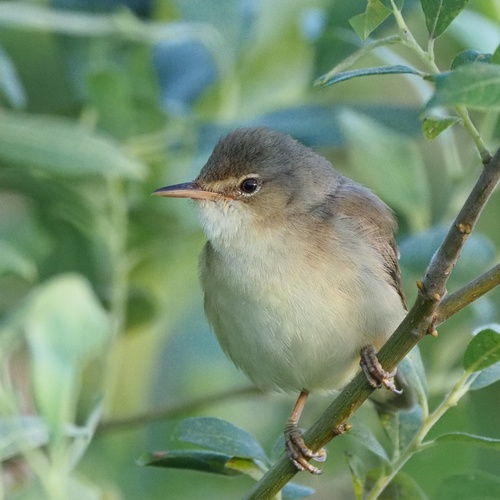
Marsh Warbler
Acrocephalus palustris
A master of vocal disguise, the Marsh Warbler weaves the songs of dozens of other birds into a breathtaking acoustic tapestry. This elusive traveler bridges the gap between European summers and African winters, hiding in plain sight among the tall weeds.
Quick Identification
Size
Length: 12.5–14 cm (4.9–5.5 in); Wingspan: 18–21 cm (7.1–8.3 in); Weight: 11–14 g (0.39–0.49 oz)
Colors
Upperparts are olive-brown to grey-brown; underparts are creamy-white or pale buff. Legs are typically a pale pinkish-brown or orange-flesh color. Males and females look identical.
Key Features
- Greyish-olive upperparts with no streaks
- Pale pinkish-orange legs and feet
- Short primary projection compared to similar warblers
- Steep forehead and a relatively pointed bill
- Creamy-white throat that stands out when singing
When You’ll See Them
Geographic range
Where Does the Marsh Warbler Live?
The Marsh Warbler is a classic Palearctic migrant, nesting across much of temperate Europe from southeast England and France through to western Russia and the Caspian Sea. During the northern winter, the entire population migrates to Southeast Africa, concentrating in countries from Kenya down to South Africa. It is a specialist of river valleys and damp meadows, avoiding both deep forests and arid deserts during its long-distance travels.
Basemap © OpenStreetMap contributors
Behavior
The Marsh Warbler is nature's ultimate acoustic thief. It is best known for its extraordinary song, which consists almost entirely of imitations of other birds. A single male may incorporate the calls of up to 70 different species—both from its European breeding grounds and its African wintering quarters—into a seamless, high-speed medley. Unlike many of its relatives, it rarely sings from open perches, preferring to stay hidden within dense, tall vegetation.
These birds are highly migratory and spend only a short time on their breeding grounds, often arriving late in May and departing by August. They are solitary and territorial during the nesting season, though they can be found in loose 'colonies' where habitat is ideal. Because they spend so much time in thick cover, they are far more often heard than seen, moving with a restless, jerky agility through tangled stalks and leaves.
EverydayEarth exclusive
Camera Tips
To capture a Marsh Warbler, place your camera low—between 0.5 and 1 meter (2-3 feet) off the ground—and aim it at a dense stand of tall, 'rank' vegetation like nettles or meadowsweet. These birds are vertical climbers, so a camera with a wide vertical field of view or a slightly upward angle is ideal for catching them as they hop between stalks. Avoid placing the camera in deep woods; focus instead on the sunny edges of wetlands or overgrown garden corners.
Because they are insect-eaters, they won't visit standard seed feeders. A better strategy is to use a shallow water basin or a solar-powered mister. The sound of moving water is a powerful lure for warblers moving through thick cover. Since these birds are extremely active and nervous, set your camera to its fastest trigger speed and use a high frame rate for video to ensure you don't just get a blur of feathers as they dart past.
Identifying this species on camera is notoriously difficult because they look nearly identical to Reed Warblers. To get a 'definitive' shot, try to position your camera so it captures the bird's profile in bright, natural light. This will help highlight the pale pinkish legs and the olive-grey tone of the back, which are key diagnostic features. High-resolution 4K video is highly recommended to distinguish the subtle wing feather lengths (primary projection) that separate them from their cousins.
Similar Species
Species that look similar or are commonly confused with Marsh Warbler.
Frequently Asked Questions
Record Marsh Warbler at your habitat
Connect a camera to start building your own species record — AI identifies every visitor automatically.