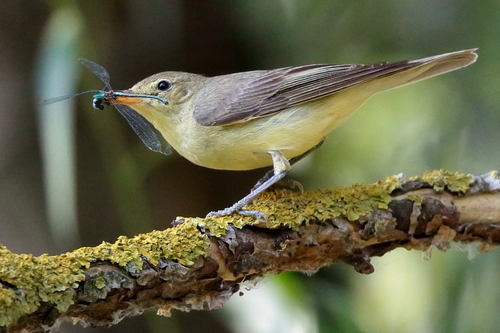
Icterine Warbler
Hippolais icterina
With its vibrant lemon-yellow breast and impressive talent for vocal mimicry, the Icterine Warbler is a true jewel of the European summer. This acrobatic songbird travels thousands of miles from Africa each year to fill the canopy with its energetic melodies.
Quick Identification
Size
Length 13–15 cm (5.1–5.9 in), wingspan 20–24 cm (7.9–9.4 in), weight 11–16 g (0.4–0.6 oz)
Colors
Bright lemon-yellow underparts and throat; greenish-olive upperparts; pale wing panel formed by light edges on feathers. No significant difference between males and females.
Key Features
- Bright lemon-yellow throat and breast
- Distinctive blue-grey or lead-colored legs
- Large, heavy-based bill with an orange-tinged lower mandible
- Relatively long wings and a steep, peaked forehead profile
When You’ll See Them
Geographic range
Where Does the Icterine Warbler Live?
The Icterine Warbler is a seasonal resident of the Western Palearctic, breeding across a wide belt of mainland Europe and Western Asia. Its core range extends from northeastern France and Scandinavia through Germany, Poland, and Russia, reaching as far east as the Ob River in Siberia. As a long-distance migrant, it abandons these northern territories in late summer to spend the winter months in the savannas and woodlands of sub-Saharan Africa, particularly in the southern and eastern regions.
Basemap © OpenStreetMap contributors
Behavior
The Icterine Warbler is a lively and restless bird, often found flitting through the upper canopy of broadleaf trees. Despite their bright yellow plumage, they can be surprisingly difficult to spot among the sun-dappled leaves as they blend in with the shifting light. They are famous for their loud, eccentric song, which is a fast-paced medley of rattles and whistles that often includes expert mimicry of other bird species found in their habitat, such as swallows or blackbirds.
During the breeding season, they are territorial and vocal, with males singing from prominent perches to defend their space and attract mates. While they generally avoid dense ground cover, they are not particularly shy of humans and can often be found in large, mature gardens or urban parks where tall trees are present. They are solitary outside of the breeding season and remain highly active throughout the day as they hunt for prey, often hovering briefly to snatch insects from the underside of leaves.
EverydayEarth exclusive
Camera Tips
To capture an Icterine Warbler on a backyard camera, placement is everything. Since these birds spend most of their time in the mid-to-high canopy, a ground-level camera is unlikely to see them unless you have a water source. Installing a camera 5 to 8 feet high, angled slightly upward toward a favorite singing perch or a sun-dappled branch near the edge of a tree’s foliage, will yield the best results for capturing their natural foraging behavior.
Water is a major draw for this species during the height of summer. An elevated birdbath or a dripper system positioned near mature trees will often lure them down from the canopy for a drink or a bath. Set your camera to a high-speed trigger or video mode with at least 60fps, as their movements are incredibly quick and jerky. They are most active and vocal in the early morning hours, so ensure your camera is positioned to avoid direct lens flare from the rising sun while still benefiting from early light.
During the late summer months of July and August, you can increase your chances of a sighting by placing cameras near berry-bearing shrubs like elderberry, currant, or serviceberry. They often descend from the tall trees to feed on these fruits to fuel up before starting their long migration to Africa. Use a narrow-angle lens if possible to get a clear, detailed shot of their distinctive blue-grey legs and lemon-yellow throat, which are the primary markers needed to distinguish them from similar-looking warblers.
Similar Species
Species that look similar or are commonly confused with Icterine Warbler.
Melodious Warbler
Very similar appearance but has shorter wings and brownish legs; found primarily in Southwestern Europe where the Icterine is absent.
Willow Warbler
Smaller with much duller, olive-yellow coloring and dark legs, lacking the Icterine's heavy bill and vibrant yellow breast.
Wood Warbler
Shows a much brighter yellow throat and a starkly white belly, whereas the Icterine is yellow throughout its entire underparts.
Frequently Asked Questions
Record Icterine Warbler at your habitat
Connect a camera to start building your own species record — AI identifies every visitor automatically.