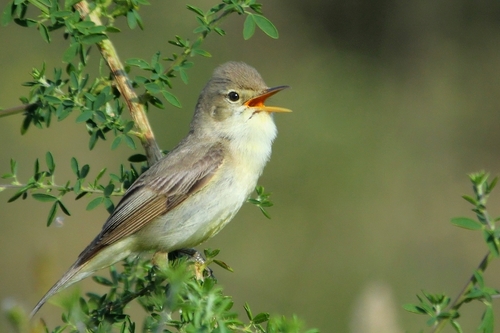
Melodious Warbler
Hippolais polyglotta
The Melodious Warbler is a vibrant summer guest known for its acrobatic foraging and a song so complex it often mimics its neighbors. A splash of lemon-yellow in the garden, this Mediterranean traveler is a favorite for backyard birdwatchers.
Quick Identification
Size
Length 12–13.5 cm (4.7–5.3 in), wingspan 17–20 cm (6.7–7.9 in), weight 10–14 g (0.35–0.5 oz)
Colors
Olive-brown upperparts, pale to vibrant lemon-yellow underparts, brownish-pink legs, and a pale wing panel
Key Features
- Strong, broad-based bill with an orange-flesh lower mandible
- Short wings with a rounded profile compared to the Icterine Warbler
- Uniformly yellowish throat and breast
- Steep forehead giving a 'high-crowned' look
When You’ll See Them
Geographic range
Where Does the Melodious Warbler Live?
This charming traveler is a classic Western Palearctic species, making its home across Southwest Europe and Northwest Africa during the warmer months. Its breeding heartland spans through France, Spain, Portugal, and Italy, where it thrives in sun-drenched, scrubby landscapes and suburban edges. As a long-distance migrant, it journeys across the Sahara to spend the winter months in the lush savannas and forest edges of sub-Saharan West Africa.
Basemap © OpenStreetMap contributors
Behavior
The Melodious Warbler is a tireless and energetic forager, rarely staying in one spot for more than a few seconds. It moves through the canopy and dense scrub with a restless, hopping gait, frequently gleaning insects from the undersides of leaves. Unlike some of its more reclusive cousins, this species is relatively bold and will often sing from an exposed branch or the top of a bush, though it quickly dives into cover if it senses a threat.
Its social life is largely solitary outside of the breeding season. During the spring and summer, males become highly territorial, using their complex and imitative songs to defend their patch of scrubland. They are known for their 'musical' mimicry, often weaving the calls of other birds into their own rapid, bubbling delivery. While they are migratory, they show high site fidelity, often returning to the same garden or thicket year after year.
EverydayEarth exclusive
Camera Tips
To capture the Melodious Warbler on camera, focus your efforts on water. These warblers are highly attracted to shallow bird baths, misters, or small moving water features, especially during the hot afternoon hours. Position your camera about 1 to 1.5 meters from the water source at a low angle to get eye-level shots that capture the bird's vibrant yellow chest and its reflection in the water.
Placement near 'transition zones' is key. Set up your gear where a dense hedge meets an open lawn or garden path. The Melodious Warbler prefers to stay close to cover, so a camera aimed at a sunlit branch just outside a thick bush is an ideal 'stage' for capturing them as they emerge to sing or forage. Ensure the background is far enough away to create a soft blur, making the bird’s olive and yellow tones pop.
Because these birds move with incredible speed, use a camera with a high-speed trigger (less than 0.3 seconds) and set it to take 3-5 photo bursts or short 10-second video clips. Standard trail cameras might only catch a tail disappearing out of frame, so high-sensitivity settings are a must. If your camera records audio, this is a huge advantage, as their signature babbling song is often the best way to confirm an identification.
In terms of lures, you don't need traditional feeders. Instead, maintain a 'wild' corner of your garden to encourage natural insect populations. In late July and August, planting berry-bearing shrubs like elderberry or wild blackberry can act as a natural magnet, as the birds fuel up on fruit before their long migration to Africa. These shrubs provide both food and the perfect photogenic backdrop.
Similar Species
Species that look similar or are commonly confused with Melodious Warbler.
Icterine Warbler
Longer wings and more pointed wingtips; prefers slightly more wooded, cooler habitats in Northern and Eastern Europe.
Willow Warbler
Smaller with a much thinner bill and lacks the bright yellow underparts and orange-tinted mandible of the Melodious Warbler.
Common Chiffchaff
Darker legs and a very simple 'chiff-chaff' song, lacking the complex mimicry and bright yellow hues.
Frequently Asked Questions
Record Melodious Warbler at your habitat
Connect a camera to start building your own species record — AI identifies every visitor automatically.