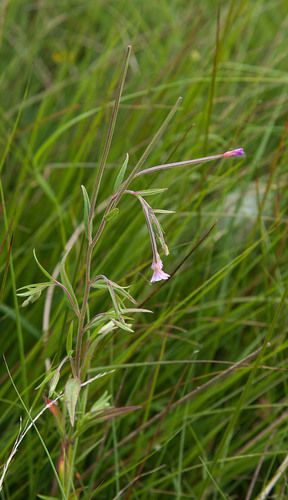
marsh willowherb
Epilobium palustre
A delicate specialist of the northern wetlands, the marsh willowherb is a master of survival in boggy ground. Its tiny, pale pink flowers and wind-dispersed seeds make it a fascinating study for any backyard naturalist with a damp corner or rain garden.
Quick Identification
Size
10–60 cm (4–24 inches) tall; flowers 5–8 mm (0.2–0.3 inches) in diameter
Colors
Pale pink to white flowers; grayish-green stems; narrow, dull green leaves
Key Features
- Narrow, linear leaves with slightly down-curved edges
- Smooth, rounded stems without the raised lines common in other willowherbs
- Small, four-petaled flowers that often nod before opening
- Long, slender seed capsules that split to release silky-tufted seeds
When You’ll See Them
Geographic range
Where Does the marsh willowherb Live?
The marsh willowherb is a hardy circumboreal species, meaning it is found throughout the northernmost reaches of the Northern Hemisphere. It is widely distributed across the United States and Canada, stretching from Alaska to Newfoundland and south into the Great Lakes and Appalachian regions. Beyond North America, its range extends across Greenland, the United Kingdom, northern Europe, and through the vast temperate regions of Russia and Northern Asia, typically favoring cooler, high-latitude or high-altitude environments.
Basemap © OpenStreetMap contributors
Behavior
Marsh willowherb is a perennial wildflower that thrives in the saturated, low-nutrient soils of northern wetlands. Unlike its more aggressive cousins that take over garden borders, this species is a quiet specialist, often found growing amidst mosses and sedges. It spends the early spring as a small rosette before sending up a slender, upright stem that can be slightly branched or simple, depending on the available light and nutrients.
The plant blooms throughout the summer, producing delicate flowers that are primarily self-pollinating, though they are frequently visited by small syrphid flies and bees. As the season ends, the plant focuses its energy on its distinctive seed pods. These long, pod-like capsules eventually dry out and peel open from the top, releasing hundreds of tiny seeds equipped with white, silky hairs that allow them to be carried long distances by the wind.
EverydayEarth exclusive
Camera Tips
To successfully capture marsh willowherb on your backyard or trail camera, you need to think like a macro photographer. Because the plant is relatively short and slender, mount your camera on a low-profile stake or a ground-level tripod. Position the lens about 12 to 18 inches away from a cluster of flower buds to ensure the AI can lock onto the distinctive four-petaled flowers as they bloom. A side-on angle is usually better than a top-down view, as it captures the nodding habit of the buds and the narrow leaf structure.
Since this plant doesn't move on its own, your camera's motion sensor might not trigger unless there is a breeze. If your camera supports time-lapse mode, set it to take a photo every 30 minutes during the peak flowering weeks of July and August. This is the best way to document the incredible transformation of the flowers into long, spindly seed capsules. If you’re using a video-capable trail cam, set it to the highest resolution possible to catch the tiny, hair-like features on the stem that distinguish this species from its relatives.
Pay close attention to lighting, as the pale pink or white petals can easily become 'blown out' and lose detail in harsh midday sun. The best footage is often captured during the 'blue hour' just after sunrise, when the wetland mist provides a soft-box effect and dew drops may be clinging to the plant. If you are specifically looking to capture the insects that visit the marsh willowherb, place your camera so the flowers are backlit by the afternoon sun; this will highlight the translucent wings of visiting flies and bees, making for more dramatic and clear footage.
Similar Species
Species that look similar or are commonly confused with marsh willowherb.
Frequently Asked Questions
Record marsh willowherb at your habitat
Connect a camera to start building your own species record — AI identifies every visitor automatically.