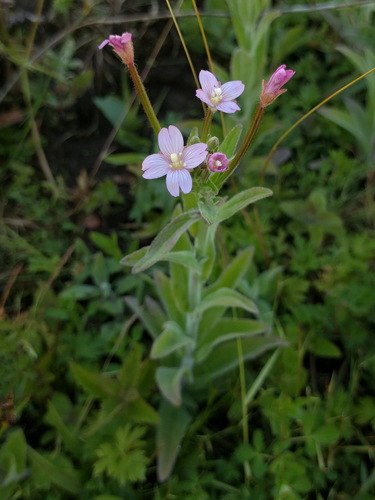
Hoary Willowherb
Epilobium parviflorum
With its soft, downy stems and delicate notched petals, the Hoary Willowherb is a subtle beauty of the damp garden. This small-flowered perennial is a favorite for pollinators and a perfect subject for macro backyard photography.
Quick Identification
Size
Stands 30–80 cm (12–31 in) tall; individual flowers are 6–9 mm (0.25–0.35 in) in diameter.
Colors
Pale pink to light purple petals; greyish-green stems and leaves due to dense, fine white hairs.
Key Features
- Four deeply notched pink petals forming a small cross
- Densely covered in soft, short hairs (hoary) on stems and leaves
- Lance-shaped leaves that are sessile (stalkless) and slightly clasp the stem
- Four-lobed stigma visible at the center of the flower
When You’ll See Them
Geographic range
Where Does the Hoary Willowherb Live?
Native to Europe, North Africa, and Western Asia, the Hoary Willowherb is a widespread temperate species. It is commonly found throughout the United Kingdom and continental Europe, reaching as far east as the Himalayas. In North America, it is an introduced species that has become naturalized across the northeastern United States and southeastern Canada, particularly around the Great Lakes region.
Basemap © OpenStreetMap contributors
Behavior
The Hoary Willowherb is a resilient perennial that thrives in damp, disturbed environments. Unlike its more aggressive relatives, it tends to grow in modest clumps rather than sprawling colonies. It spends the early spring establishing a leafy base before sending up its hairy flowering stalks as the weather warms. The plant is a vital part of the local ecosystem, offering nectar to small bees and hoverflies during the mid-summer months.
A fascinating aspect of its behavior is its reproductive strategy. Once the small flowers are pollinated, they develop into long, slender seed pods that eventually split open to release hundreds of tiny seeds. Each seed is attached to a tuft of silky white hair, allowing the wind to carry them to new damp patches of soil. In a backyard setting, it is often found near leaky outdoor taps, pond edges, or in moist, neglected garden borders.
EverydayEarth exclusive
Camera Tips
Capturing the Hoary Willowherb requires a focus on macro details to distinguish it from its cousins. Because the flowers are relatively small, position your camera on a low tripod or ground mount, roughly 12 to 20 inches from the ground. Aim for a side-on angle that captures both the notched petals of the flower and the distinctive 'hoary' or fuzzy texture of the stem. Using a camera with a high-resolution sensor will help the AI identify the four-lobed stigma, which is a primary identifying feature.
Timing and lighting are critical for plant photography. The pale pink petals can easily become 'blown out' or overexposed in the harsh midday sun. For the most evocative shots, schedule your camera to capture images during the early morning or late afternoon golden hours. The low-angle light will catch the fine hairs on the stem, creating a beautiful backlit 'glow' that makes the plant stand out from the background vegetation. If your camera has a time-lapse mode, trigger a shot every hour over the course of a sunny July day to watch the blooms open and close.
Since willowherbs grow in damp areas where the ground may be soft, ensure your camera mount is stable. Wind is the biggest enemy of clear plant photos; even a slight breeze can cause the thin stems to blur. If you are setting up a semi-permanent station, consider using a small garden stake to gently support the stem just out of the camera's frame. This keeps the subject still for the sharpest possible images, allowing the AI to clearly see the leaf attachments, which are key for a positive species ID.
Similar Species
Species that look similar or are commonly confused with Hoary Willowherb.
Great Willowherb
Much larger flowers (up to 2cm) and a significantly taller growth habit, often reaching 2 meters.
Broad-leaved Willowherb
Lacks the dense, greyish hairs on the stem and has leaves with distinct stalks (petioles).
Marsh Willowherb
Has a creeping base and much narrower, almost hairless leaves compared to the 'hoary' texture of parviflorum.
Frequently Asked Questions
Record Hoary Willowherb at your habitat
Connect a camera to start building your own species record — AI identifies every visitor automatically.