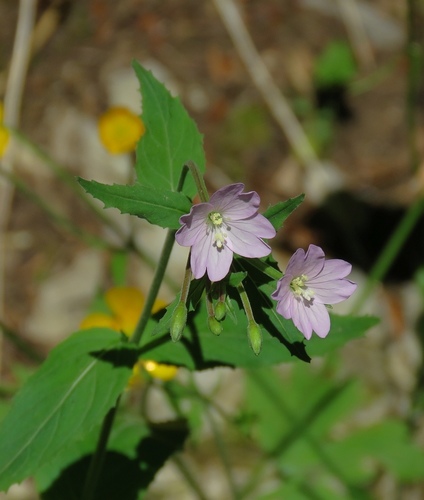
Broad-leaved Willowherb
Epilobium montanum
A resilient and delicate beauty of the backyard, the Broad-leaved Willowherb is famous for its 'X-shaped' stigma and its ability to spread its silky seeds on the wind. While often called a weed, it is a fascinating pioneer species that brings life to garden corners and woodland edges.
Quick Identification
Size
20–60 cm (8–24 inches) in height with a spread of approximately 15–30 cm (6–12 inches)
Colors
Pale pink to lilac-purple petals, dull green leaves often with reddish-tinted stems
Key Features
- Four-lobed white stigma forming a distinct 'X' shape
- Opposite, stalked, ovate leaves with sharply serrated margins
- Slender, rounded stems that are often slightly hairy
- Small, four-petaled flowers measuring 6-10mm across
When You’ll See Them
Geographic range
Where Does the Broad-leaved Willowherb Live?
This adaptable wildflower is primarily native to Europe and Western Asia, where it is a ubiquitous sight from the British Isles across to the Himalayan mountains. It has successfully expanded its footprint through human activity and is now found as an introduced species in parts of North America, Japan, and New Zealand. In its native range, it is remarkably common in almost every temperate habitat, from lowland valleys to sub-alpine slopes.
Basemap © OpenStreetMap contributors
Behavior
The Broad-leaved Willowherb is a hardy and opportunistic perennial known for its ability to colonize disturbed ground quickly. In the backyard setting, it often appears as a 'volunteer' in flowerbeds, alongside walls, or in the shade of hedgerows. It is a master of self-propagation; while it can cross-pollinate via insects, it is also highly efficient at self-pollination, ensuring seed production even in the absence of pollinators.
As the season progresses, the plant develops long, slender seed pods. When ripe, these pods split longitudinally to reveal hundreds of tiny seeds, each equipped with a tuft of silky white hairs. These 'parachutes' allow the seeds to be carried long distances by the slightest breeze, which is why the species is so widespread in urban and suburban environments. Despite its reputation as a garden weed, it provides a valuable mid-summer nectar source for hoverflies and small bees.
EverydayEarth exclusive
Camera Tips
To capture the delicate beauty of the Broad-leaved Willowherb, you should move your camera away from the standard trail height and bring it down to the plant's level, approximately 30 to 50 centimeters off the ground. Using a macro lens or a camera with a strong close-up capability is vital to showcase the unique 'X' shaped stigma and the fine, serrated edges of the leaves. Position the camera so that the morning sun hits the petals from the side, which will highlight the translucent quality of the lilac-pink flowers.
Because this plant stays in one place, it is an ideal subject for a long-term timelapse. Set your camera to take a photo every 20 minutes from late June through July. You can record the fascinating process of the flower buds nodding downward before straightening up to bloom, followed by the dramatic 'explosion' of the seed pods. Ensure your tripod is weighted down, as even small vibrations from wind can blur the fine details of the plant's silky seed tufts.
If your goal is to capture wildlife interaction, aim your camera at a healthy cluster of willowherb that is receiving at least partial sunlight. This species is a frequent stop for hoverflies and small solitary bees. To freeze the motion of these fast-moving insects, use a fast shutter speed (1/1000s or higher) and ensure there is plenty of natural light. The plant is also a host for the Elephant Hawk-moth caterpillar, so keep an eye on the lower leaves for large, brown, trunk-like larvae during the late summer months.
Finally, consider the background of your shot. In a suburban backyard, a messy fence or garden hose can ruin the 'wild' feel of the photo. Use a wide aperture (f/2.8 or f/4) to create a soft, blurred background (bokeh) that keeps the viewer's focus entirely on the intricate structure of the willowherb. If you are using a motion-activated camera, set the sensitivity to high, as the gentle swaying of the plant in the breeze or the landing of a small insect may not always trigger a standard sensor.
Similar Species
Species that look similar or are commonly confused with Broad-leaved Willowherb.
Frequently Asked Questions
Record Broad-leaved Willowherb at your habitat
Connect a camera to start building your own species record — AI identifies every visitor automatically.