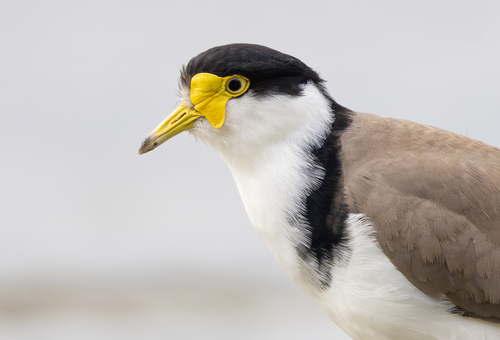
Masked Lapwing
Vanellus miles
The bold architect of the suburban lawn, the Masked Lapwing is impossible to miss with its striking yellow wattles and fearless personality. A master of the 'swoop,' this charismatic ground-dweller is a fascinating study in parental devotion and urban adaptation.
Quick Identification
Size
33–38 cm (13–15 in) length; 75–85 cm (30–33 in) wingspan; 230–400 g (8–14 oz)
Colors
Brown upperparts, white underparts, black crown, and large, fleshy yellow facial wattles. Yellow legs and yellow spurs on the wings.
Key Features
- Fleshy yellow facial wattles
- Loud, staccato 'kerr-kerr-kerr' call
- Small yellow spurs on the wing wrists
- Large, ground-dwelling build with white belly
When You’ll See Them
Geographic range
Where Does the Masked Lapwing Live?
Native to the Australian continent, the Masked Lapwing is found across the vast majority of Australia, New Guinea, and neighboring islands. It has successfully established itself in New Zealand over the last century, where it is known as the Spur-winged Plover, and continues to expand its reach into suburban gardens and cleared agricultural land across Oceania. These birds are highly adaptable and are among the few native species that have thrived due to urban sprawl and the clearing of forests for pasture.
Basemap © OpenStreetMap contributors
Behavior
The Masked Lapwing is a highly conspicuous and territorial ground-dweller. They are famously bold, often choosing to nest in seemingly high-traffic areas like school ovals, golf courses, and suburban lawns. While they spend much of their day foraging for food, they are notably active and vocal at night, often heard calling out as they fly overhead in the darkness. They are socially monogamous, usually seen in pairs or small family groups.
The species is most famous for its defensive behavior during the nesting season. When protecting their eggs or chicks, which are hidden in simple scrapes on the ground, the adults will swoop at intruders—including humans and dogs—while emitting a piercing alarm call. Despite the presence of sharp spurs on their wings, they rarely make physical contact, preferring to use intimidation to drive threats away.
EverydayEarth exclusive
Camera Tips
To capture high-quality footage of a Masked Lapwing, place your AI-powered camera at a very low angle, roughly 10 to 15 centimeters (4-6 inches) off the ground. These birds are strictly terrestrial foragers and will look most impressive when filmed from their own eye level. Aim the camera across a flat expanse of lawn or short-cropped grass, as lapwings avoid tall vegetation where predators might hide. Because they are active during the night, ensure your camera has a strong infrared flash or high-sensitivity sensor to capture their nocturnal 'moonlight foraging'.
You don't need traditional birdseed to attract them; instead, focus on soil health. Masked Lapwings are drawn to moist, pesticide-free lawns where earthworms and grubs are active. A shallow, wide ground-level birdbath is an excellent lure, as they enjoy drinking and bathing in open spaces where they have a clear 360-degree view. Avoid placing cameras near dense bushes or fences, as lapwings prefer the center of the yard.
During the breeding season (typically July to December), be extremely mindful of where you place your equipment. If you notice a lapwing standing its ground or calling loudly at you, there is likely a nest nearby—a simple scrape in the dirt. To avoid being swooped and to prevent stressing the birds, keep your camera at a distance and use a zoom lens if possible. Setting your camera to a 'burst' photo mode or 30-second video clips will help you capture their unique 'run-and-pause' hunting rhythm and the way they vibrate their feet against the ground to disturb worms.
Similar Species
Species that look similar or are commonly confused with Masked Lapwing.
Frequently Asked Questions
Record Masked Lapwing at your habitat
Connect a camera to start building your own species record — AI identifies every visitor automatically.