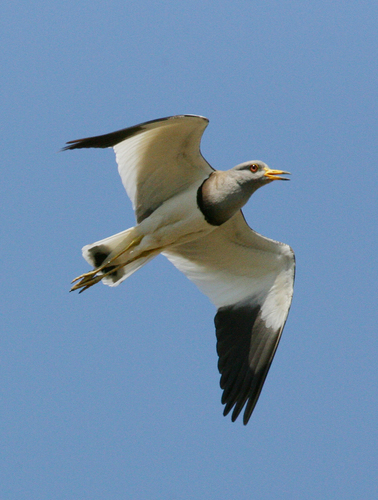
Grey-headed Lapwing
Vanellus cinereus
A striking wader of the Asian wetlands, the Grey-headed Lapwing is easily recognized by its smoky-grey hood, bold black breast band, and piercing yellow-and-black bill.
Quick Identification
Size
34–37 cm (13–15 in) length with a 70–80 cm (27–31 in) wingspan; weights range from 230–295 g (8–10.4 oz)
Colors
Soft grey head and neck, brown back, white underparts with a bold black band across the upper breast; yellow bill with a black tip and bright yellow legs
Key Features
- Distinctive grey head and neck contrast with a white belly
- Prominent black breast band separating the grey neck and white breast
- Bright yellow legs and yellow bill base with a black tip
- Striking red iris and red fleshy eye-ring
- In flight shows large white wing patches against black primaries
When You’ll See Them
Geographic range
Where Does the Grey-headed Lapwing Live?
Native to the eastern Palearctic and Indomalayan realms, the Grey-headed Lapwing breeds primarily across Northeast China and Japan. As a migratory species, its core wintering range extends across northern Southeast Asia, encompassing northeastern India, Bangladesh, Myanmar, Thailand, Vietnam, and Cambodia. Some populations in Japan are partial migrants, wintering in the more temperate regions of southern Honshū.
Basemap © OpenStreetMap contributors
Behavior
The Grey-headed Lapwing is a vocal and territorial shorebird known for its alert and somewhat assertive personality. During the breeding season, they are fiercely protective of their nesting sites, often performing aerial displays or diving at intruders to drive them away. They possess a characteristic 'lapwing' gait—a series of quick, short runs followed by a sudden halt and a tilt of the body to peck at prey in the soil.
While they are solitary or found in pairs during the breeding months in China and Japan, they become much more social in the winter. In their wintering grounds across Southeast Asia, you might spot them in small, loose flocks foraging together in harvested rice fields or along the muddy margins of wetlands. They are generally wary of humans and will take flight with a loud, piercing 'chee-it' call if approached too closely.
EverydayEarth exclusive
Camera Tips
To capture the Grey-headed Lapwing, placement is everything. These birds prefer open ground with high visibility, so place your camera low to the ground (approximately 12–18 inches high) at the edge of a rice paddy, marsh, or large damp lawn. Avoid thick vegetation, as they rarely enter dense cover. Aim the camera horizontally to capture their long-legged profile and the striking contrast of their black breast band against their white belly.
Because they are highly sensitive to movement, use a camera with a fast, silent shutter and a high-speed trigger. They are most active during the golden hours of early morning and late afternoon; the low-angle sun during these times beautifully highlights the red iris of their eyes and the yellow of their bill and legs. If your camera has a burst mode, enable it to catch their 'run-and-pause' foraging behavior.
While they aren't easily lured by traditional birdseed, you can encourage them to linger in front of your lens by maintaining a 'mudflat' effect—a patch of very short grass or bare, damp earth where earthworms and soil insects are plentiful. If you are in a suburban area near a wetland, keeping a shallow, wide birdbath at ground level can also serve as a draw for them to drink and preen.
During the breeding season, these birds are exceptionally noisy. If your AI-powered camera supports video with audio, ensure it is turned on. Their loud, sharp alarm calls are a classic sound of the Asian countryside and provide great context to your backyard wildlife recordings. Seasonal timing is key: look for them in northern regions during the spring and summer, and in southern regions during the winter months.
Similar Species
Species that look similar or are commonly confused with Grey-headed Lapwing.
Northern Lapwing
Features a long, thin black crest and a dark, iridescent green back, whereas the Grey-headed is crestless with a brown back.
Red-wattled Lapwing
Has a black head and throat with prominent red fleshy wattles in front of the eyes, unlike the uniform grey head of the Grey-headed Lapwing.
Frequently Asked Questions
Record Grey-headed Lapwing at your habitat
Connect a camera to start building your own species record — AI identifies every visitor automatically.