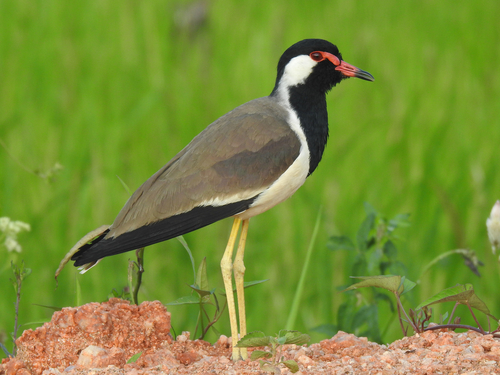
Red-wattled Lapwing
Vanellus indicus
The Red-wattled Lapwing is the vigilant sentinel of the backyard, easily recognized by its striking red face and the unmistakable 'did-he-do-it' call that echoes across the plains.
Quick Identification
Size
Length of 32–35 cm (12.5–14 in), wingspan of approx 80 cm (31.5 in), and weight between 170–290 g (6–10 oz).
Colors
Light brown upperparts with a bronze-green sheen; black head, neck, and upper breast; white patch running from the eye down the neck to the white underparts; striking red fleshy wattles in front of the eyes.
Key Features
- Bright red fleshy wattle in front of the eyes
- Long, spindly yellow legs and a red bill with a black tip
- Loud, piercing 'did-he-do-it' alarm call
- White wing bar visible during flight
When You’ll See Them
Geographic range
Where Does the Red-wattled Lapwing Live?
Native to the diverse landscapes of Southern and Southwestern Asia, the Red-wattled Lapwing is a common sight from the Middle East through the Indian subcontinent and into Southeast Asia. Its core range spans countries like India, Pakistan, Sri Lanka, Iran, and Thailand, where it thrives in both rural and developing urban areas. While they are predominantly resident birds, they are known to make local movements based on the availability of water and seasonal rains, though they have not established significant introduced populations outside their native Asian continent.
Basemap © OpenStreetMap contributors
Behavior
The Red-wattled Lapwing is a bold and highly vocal ground-dweller, famous for its role as the 'sentinel' of the fields. They are almost never seen perching, preferring to spend their lives on the ground where they run in short spurts before pausing to scan for prey. They are intensely territorial, especially during the breeding season, and will not hesitate to harass much larger animals or humans if they feel their nesting site is threatened.
These birds are known for their remarkable defensive displays. To protect their ground-level nests, adults will perform 'distraction displays,' such as faking a broken wing to lead predators away from their eggs. They are also partially nocturnal, often heard calling late into moonlit nights. In urban and suburban settings, they have adapted well to human presence, though they remain wary and will announce any visitor with their signature 'did-he-do-it' cry.
EverydayEarth exclusive
Camera Tips
Capturing the Red-wattled Lapwing requires a ground-focused strategy. Since these birds are strictly terrestrial and never perch in trees, your AI-powered camera should be mounted very low—ideally between 6 to 12 inches off the ground. Position the camera facing a flat, open patch of short grass or bare soil where the bird has a clear line of sight, as they prefer areas where they can see predators coming from a distance.
Water is the best natural lure for this species. If you have a shallow garden pond or a low-profile birdbath, aim your camera at the muddy edge or the water's entry point. They are particularly active during the transitions between day and night, so ensure your camera is set to capture high-quality images in low-light conditions. Because they move in a 'run-and-pause' fashion, a fast trigger speed is essential to catch them while they are stationary and scanning the ground.
During the breeding months (typically March to August), be on the lookout for their simple ground nests, which are often just small scrapes lined with pebbles. If a lapwing is frequenting a specific spot in your yard, it may be nesting. Do not place the camera too close to a suspected nest, as the parents are extremely protective and may attack the equipment or become stressed. Instead, use a zoom lens or place the camera 10-15 feet away to capture their fascinating parental behaviors, such as 'soaking' their belly feathers in water to cool their eggs or chicks.
Similar Species
Species that look similar or are commonly confused with Red-wattled Lapwing.
Frequently Asked Questions
Record Red-wattled Lapwing at your habitat
Connect a camera to start building your own species record — AI identifies every visitor automatically.