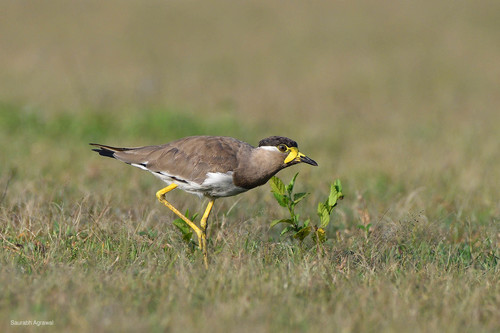
Yellow-wattled Lapwing
Vanellus malabaricus
With its striking yellow facial wattles and a bold black cap, the Yellow-wattled Lapwing is the charismatic sentry of the Indian dry plains.
Quick Identification
Size
Length: 26–28 cm (10–11 in); Wingspan: 70–80 cm (27–31 in); Weight: 110–200g (3.9–7 oz)
Colors
Dull grey-brown body with a white belly, black cap, and prominent yellow triangular wattles at the base of the beak; legs are bright yellow.
Key Features
- Distinctive yellow facial wattles
- Solid black cap with a white border
- Long, bright yellow legs
- Pointed, sandy-brown wings with black flight feathers
When You’ll See Them
Geographic range
Where Does the Yellow-wattled Lapwing Live?
Where Does the Yellow-wattled Lapwing Live? This species is a proud endemic of the Indian subcontinent, found extensively across the dry regions of peninsular India. Its range extends into the arid plains of Pakistan to the west and the lowlands of Nepal and Bangladesh to the north and east, while also being a common resident in the dry zones of Sri Lanka. They are masters of open terrain, specifically avoiding dense forests and high-altitude mountains in favor of sun-drenched, flat landscapes.
Basemap © OpenStreetMap contributors
Behavior
The Yellow-wattled Lapwing is a quintessential ground bird, characterized by its confident, upright stance and a rhythmic 'run-and-pause' foraging technique. Unlike many other birds, they are most comfortable on open, stony ground where their dull grey-brown plumage provides near-perfect camouflage against the parched earth. They are highly territorial during the nesting season and are famous for their vocal displays, emitting a sharp, metallic 'tee-it' call that rings across the dry plains when they feel threatened.
Socially, these birds are typically seen in pairs or small family groups. They exhibit fascinating parental care; when a predator or human approaches their ground nest, the parents will often lead the intruder away using elaborate distraction displays. The chicks are nidifugous, meaning they are ready to leave the nest and follow their parents just hours after hatching, looking like tiny, walking puffballs of camo-patterned down.
EverydayEarth exclusive
Camera Tips
Capturing the Yellow-wattled Lapwing requires a ground-level strategy, as these birds spend the vast majority of their time on foot. Position your camera just 6 to 12 inches off the ground, ideally mounted on a small stake or a low-profile tripod. Angle the lens slightly upward if you are monitoring a slope, or keep it level to the horizon if you are targeting a flat, stony patch of ground where they often forage. Because they are shy and have excellent eyesight, ensure your camera is well-camouflaged or tucked near a small shrub to avoid spooking them.
While traditional bird feeders won't attract this insectivore, a shallow, ground-level water feature or a 'dust bath' area can be a magnet. Lapwings are particularly attracted to areas of short grass or recently cleared earth where insects are easily spotted. If you are setting up in a backyard, a simple pan of water placed in an open, sunlit area is your best bet for a clear shot. During the breeding season (March to August), look for their scrape nests on stony ground; however, keep your distance and use a telephoto or remote setup to ensure you do not disturb their nesting attempts.
Technically, you should prioritize a fast trigger speed and a high-quality PIR sensor. Yellow-wattled Lapwings are capable of sudden, rapid flight and quick, darting runs. Set your AI camera to take short video bursts (10-15 seconds) rather than just stills, as their distinctive bobbing motion and wattle-shaking are best captured in motion. Since they are most active during the cooler parts of the day, ensure your camera's exposure settings are optimized for the golden hours of dawn and dusk, when the light will catch the brilliant yellow of their facial wattles most effectively.
Similar Species
Species that look similar or are commonly confused with Yellow-wattled Lapwing.
Frequently Asked Questions
Record Yellow-wattled Lapwing at your habitat
Connect a camera to start building your own species record — AI identifies every visitor automatically.