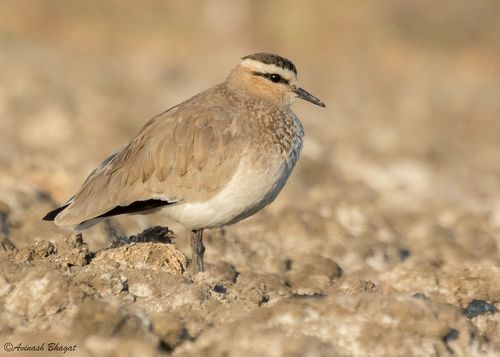
Sociable Lapwing
Vanellus gregarius
A crown jewel of the Central Asian steppes, the Sociable Lapwing is one of the world's rarest and most striking migratory birds. Known for its distinct white eyebrows and remarkable long-distance journeys, this critically endangered wader is a true ghost of the grasslands.
Quick Identification
Size
27–30 cm (10.6–11.8 in) in length, 65–75 cm (25.5–29.5 in) wingspan, weighing 150–250 g (5.3–8.8 oz)
Colors
Sand-grey upperparts, black crown, bold white eyebrow (supercilium) meeting at the nape, and a dark eye-stripe. Breeding adults feature a striking black and chestnut belly patch.
Key Features
- Bold white eyebrow stripe meeting at the back of the head
- Black crown and dark eye-stripe
- Long, dark legs and a relatively short black bill
- Distinctive black-and-chestnut belly patch in breeding plumage
When You’ll See Them
Geographic range
Where Does the Sociable Lapwing Live?
This rare traveler is native to the vast, open steppes of Central Asia, primarily breeding in Kazakhstan and south-central Russia. As a fully migratory species, it travels along complex flyways to spend the winter in the Middle East, the Indian subcontinent, and Northeast Africa. Key wintering sites are found in countries such as India, Pakistan, Sudan, Saudi Arabia, and occasionally Israel, with the birds often favoring arid plains and traditional agricultural landscapes during their stay. There are no introduced populations, as this species is currently struggling to maintain its native numbers.
Basemap © OpenStreetMap contributors
Behavior
During the breeding season, they form loose colonies in the Central Asian grasslands. They are known for being somewhat wary, often taking flight at the first sign of danger with a direct, steady wingbeat. In flight, they reveal a striking wing pattern of white secondaries and black primaries. Because they are critically endangered, their interactions with humans are increasingly rare, though they are sometimes found foraging in fallow agricultural fields alongside traditional livestock grazing areas.
EverydayEarth exclusive
Camera Tips
Capturing the Sociable Lapwing on camera requires a specialized approach because they are ground-dwelling birds of wide-open spaces. Avoid mounting your camera on trees; instead, use a low-profile ground spike or a weighted base positioned no more than 6-12 inches off the ground. This low angle provides a much more intimate view of the bird's unique facial markings and belly patterns, which are often lost when looking down from a height.
Location is everything for this rare visitor. If you are in a migration corridor or wintering area, look for patches of very short grass or fallow fields that have been recently grazed by livestock. These birds prefer open visibility. Placing your camera near a shallow, natural-looking water source—like a flat stone basin or a small depression that holds rainwater—is the most effective way to attract them without using harmful baits. They are much more likely to visit a watering hole than a feeder.
Set your camera to a fast trigger speed and use 'Burst Mode' (3-5 photos per trigger). Sociable Lapwings are fast, nervous walkers, and a single shot often catches them mid-step or with their head turned. A burst ensures you get that one clear, iconic shot of their 'sociable' interaction if a flock lands together. Since they are active during the day, prioritize settings that handle high-contrast sunlight, and if your camera allows, set the PIR sensitivity to 'High' to detect their movement against the shimmering heat of the steppe or field.
Because this species is Critically Endangered, it is vital to minimize human presence. Use a camera with a cellular connection or a long-range SD card to avoid visiting the site frequently. Disturbance at a nesting or key foraging site can have a significant impact on their survival. Always prioritize the bird's safety and comfort over getting the perfect shot.
Similar Species
Species that look similar or are commonly confused with Sociable Lapwing.
Frequently Asked Questions
Record Sociable Lapwing at your habitat
Connect a camera to start building your own species record — AI identifies every visitor automatically.