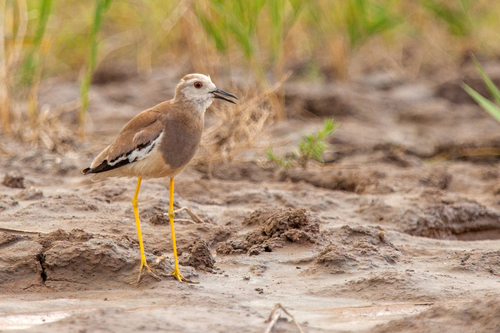
White-tailed Lapwing
Vanellus leucurus
Elegant and understated, the White-tailed Lapwing is a master of the marshlands. With its stilt-like yellow legs and a tail that flashes brilliant white in flight, this graceful wader is a prized find for any backyard observer near the water's edge.
Quick Identification
Size
26–29 cm (10–11.5 in) long; wingspan 67–70 cm (26–27.5 in); weight 140–200 g (5–7 oz)
Colors
Light sandy-brown back and wings, grey breast, white belly, and a distinctive pure white tail. Legs are bright yellow.
Key Features
- Extremely long, spindly bright yellow legs
- Pure white tail visible in flight and when standing
- Sandy-brown plumage with a greyish chest band
- Lacks the crest or facial wattles found in other lapwings
When You’ll See Them
Geographic range
Where Does the White-tailed Lapwing Live?
The White-tailed Lapwing is native to the wetlands of Central and Western Asia, with its primary breeding grounds stretching from Iraq and Iran across to southern Russia and Kazakhstan. As a migratory species, it travels south for the winter, populating the Nile Valley in East Africa, the Persian Gulf, and the Indian subcontinent. While it is a rare visitor to Europe, its core presence remains in the vast, shallow water systems of the Middle East and Central Asia where it thrives in semi-arid landscapes near permanent water.
Basemap © OpenStreetMap contributors
Behavior
The White-tailed Lapwing is a social yet relatively shy wader, often found in small groups during the winter months. Unlike some of its more aggressive and vocal relatives, such as the Red-wattled Lapwing, this species tends to be quieter and more reserved, preferring to retreat when disturbed rather than mounting a noisy defense. They spend much of their time walking slowly through shallow water or along muddy banks, using a classic 'stop-and-run' foraging technique common to many plovers.
During the breeding season, they become more territorial, though they may still nest in loose colonies where habitat is ideal. They are primarily diurnal, meaning they are active during the daylight hours, though they are known to remain active during moonlit nights. In flight, they are easily identified by their striking wing pattern, which features large white patches contrasting with black flight feathers, making them appear much more vibrant in the air than on the ground.
EverydayEarth exclusive
Camera Tips
To capture the White-tailed Lapwing, camera placement is everything. These birds are 'edge specialists,' so focus your AI-powered camera on the muddy transition zone between water and land. Aim the camera about 6 to 12 inches off the ground to match their eye level; this low-profile angle emphasizes their remarkably long yellow legs and provides a professional, intimate perspective. If you are setting up near a pond or rice field, ensure the camera faces away from the sun to avoid silhouettes, as their sandy-brown plumage can easily wash out in harsh backlighting.
While they don't respond to traditional birdseed, you can attract them to a specific spot by maintaining a 'mud-flat' area. If you have a backyard pond, keeping a section of the bank free of tall vegetation and slightly damp will encourage them to forage for invertebrates right in front of your lens. Because they are skittish, use a camera with a fast trigger speed and a 'silent shutter' mode if available, as the mechanical click of some older trail cams can startle them into flight.
During the winter migration, these birds are often more social. If you spot one, there are likely others nearby. Set your camera to burst mode or high-frequency capture. The White-tailed Lapwing's most dramatic feature—its white tail—is often hidden while standing but creates a stunning visual 'pop' when they stretch their wings or take off. High-speed video (60fps or higher) is ideal for capturing the elegant, slow-motion wing beats that reveal their complex black, white, and brown wing patterns.
Similar Species
Species that look similar or are commonly confused with White-tailed Lapwing.
Northern Lapwing
Has a prominent long head crest and a dark band on the tail, whereas the White-tailed is crestless with an all-white tail.
Red-wattled Lapwing
Features a red fleshy wattle in front of the eyes and a black head and neck, unlike the uniform sandy-brown head of the White-tailed.
Sociable Lapwing
Has a distinct dark eye stripe and crown, and its tail has a black terminal band, unlike the pure white tail of the White-tailed Lapwing.
Frequently Asked Questions
Record White-tailed Lapwing at your habitat
Connect a camera to start building your own species record — AI identifies every visitor automatically.