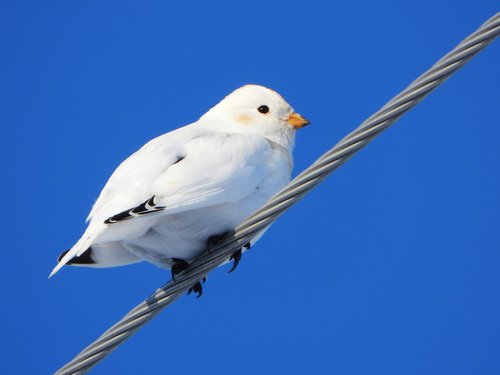
McKay's Bunting
Plectrophenax hyperboreus
The McKay's Bunting is the 'Ghost of the Bering Sea,' a stunningly white songbird that thrives in some of the harshest environments on Earth. Breeding on just two remote islands, it is a rare and prized sight for any wildlife enthusiast.
Quick Identification
Size
Length: 15–17 cm (6–7 in); Wingspan: 30–35 cm (12–14 in); Weight: 35–62 g (1.2–2.2 oz)
Colors
Predominantly white; breeding males are nearly pure white with black wingtips; females and winter birds have buff-brown or greyish washes on the crown and back.
Key Features
- Extremely white plumage compared to other buntings
- Black central tail feathers and primary wingtips
- Thick, seed-cracking bill
- Breeds only on remote Bering Sea islands
When You’ll See Them
Geographic range
Where Does the McKay's Bunting Live?
This specialized songbird is native to the northernmost regions of the Bering Sea in North America. Its breeding range is one of the most restricted of any bird on the continent, limited almost exclusively to St. Matthew and Hall Islands. During the winter, the population migrates to the western coast of Alaska, where they can be spotted from the Seward Peninsula down to the Alaska Peninsula, occasionally appearing near human settlements along the shoreline.
Basemap © OpenStreetMap contributors
Behavior
McKay's Buntings are highly social birds that are most frequently observed in small, tight-knit flocks during the winter months. They are ground-dwellers by nature, often seen hopping across windswept beaches and coastal tundra in search of food. They exhibit a unique 'rolling' flock behavior where birds at the rear fly over the group to land at the front, ensuring the entire flock moves systematically across a foraging area.
On their breeding grounds in the Bering Sea, they are known for their resilience in the face of harsh weather. They are relatively bold around the few humans they encounter, but their lifestyle is dictated by the extreme cycles of the Arctic. They are strong fliers, capable of navigating the turbulent winds of the Alaskan coast during their short but vital migrations between island nesting sites and mainland wintering grounds.
EverydayEarth exclusive
Camera Tips
To capture McKay's Bunting on camera, focus your efforts on open, coastal areas if you are located in western Alaska during the winter. These birds prefer the 'beach fringe' where seeds naturally accumulate in the wrack line. Position your AI camera very low to the ground—ideally 6 to 10 inches high—and point it toward a clear patch of sand or snow near driftwood. This low angle is essential for capturing their white plumage against the horizon and provides a much more intimate view of their foraging behavior.
Because they are ground feeders, you can attract them by scattering a high-energy mix of white proso millet, hulled sunflower seeds, and cracked corn directly on the ground. Avoid using hanging feeders, as these birds are naturally hesitant to utilize them. Creating a 'clean' patch of ground by removing a small square of snow can serve as a visual magnet for these buntings, as they are always looking for exposed ground to find seeds.
In the low-light conditions of an Alaskan winter, camera settings are crucial. Ensure your camera is set to a high trigger speed to capture their quick, hopping movements. If your camera supports it, increase the exposure compensation slightly; the vast amount of white plumage against white snow can often trick auto-exposure sensors into underexposing the shot, leaving the bird looking grey rather than brilliant white. Lastly, use a protective housing or a simple shield to keep salt spray off the lens, which is a common issue in their preferred coastal habitats.
Similar Species
Species that look similar or are commonly confused with McKay's Bunting.
Frequently Asked Questions
Record McKay's Bunting at your habitat
Connect a camera to start building your own species record — AI identifies every visitor automatically.