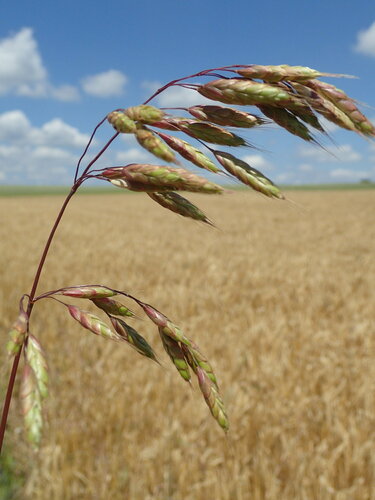
Meadow Brome
Bromus commutatus
With its elegant, drooping seed heads and soft, hairy stems, Meadow Brome adds a touch of wild grace to any backyard. Often overlooked, this resilient grass is a master of movement, turning every breeze into a visual dance.
Quick Identification
Size
Height ranges from 40–100 cm (16–40 inches); leaf blades are 5–20 cm (2–8 inches) long.
Colors
Soft green foliage; seed heads (panicles) are pale green to purplish, turning light tan or straw-colored when mature.
Key Features
- Drooping, open seed heads with long, spreading branches
- Hairy leaf sheaths, particularly on the lower part of the plant
- Smooth glumes and lemmas with short awns (bristles)
- Upright, hollow stems that sway easily in the wind
When You’ll See Them
Behavior
Meadow Brome, also known as Hairy Chess, is a cool-season annual or biennial grass that plays a quiet but vital role in the meadow ecosystem. It begins its growth cycle in the late autumn or early spring, taking advantage of moist conditions to establish a root system before the summer heat arrives. Unlike perennial grasses that spread through underground rhizomes, Meadow Brome relies entirely on its abundant seed production to colonize new areas, making it a pioneer species in disturbed soils.
In the backyard setting, this grass acts as a graceful weather vane, swaying dramatically with the slightest breeze. While some gardeners consider it a weed due to its ability to spread quickly in fallow garden beds, it provides excellent cover for ground-nesting insects and small mammals. It doesn't interact with humans directly, but its presence is a sign of a transition zone between manicured lawns and wilder, unmanaged spaces.
EverydayEarth exclusive
Camera Tips
Capturing the beauty of Meadow Brome with an AI-powered trail camera requires a shift in strategy from animal tracking. Because most trail cameras are triggered by motion and heat (PIR sensors), a swaying grass like Meadow Brome can cause thousands of 'false' triggers. To avoid this while still capturing its growth, switch your camera to 'Time-Lapse' mode. Set the interval to one photo every 15 to 30 minutes during daylight hours to create a stunning video of the grass maturing and its seed heads unfolding over several weeks.
For the most aesthetic shots, position your camera at a low angle, roughly 10 to 15 inches off the ground. This 'worm’s eye view' emphasizes the height of the stalks against the sky and captures the intricate details of the drooping panicles. If your camera has a macro or close-focus setting, use it to highlight the 'hairy' texture of the stems that gives the species its common name, Hairy Chess.
Lighting is everything when it comes to grasses. Place your camera so it faces toward the rising or setting sun (East or West). When the sun is low on the horizon, it will 'backlight' the translucent seed heads and fine hairs on the stems, creating a glowing 'halo' effect that makes the grass pop against darker backgrounds. Avoid high-noon photography, as the overhead sun can make the thin blades look washed out or invisible.
If you are using a motion-triggered camera to capture the animals that interact with the grass, such as goldfinches landing on the stalks to eat seeds, increase your 'Trigger Interval' to at least 2 minutes. This prevents the camera from firing continuously every time the wind blows. During the peak of summer (June and July), ensure the area around the camera is clear of other heavy brush so the camera's focus stays locked on the delicate structure of the Brome.
Similar Species
Species that look similar or are commonly confused with Meadow Brome.
Frequently Asked Questions
Record Meadow Brome at your habitat
Connect a camera to start building your own species record — AI identifies every visitor automatically.