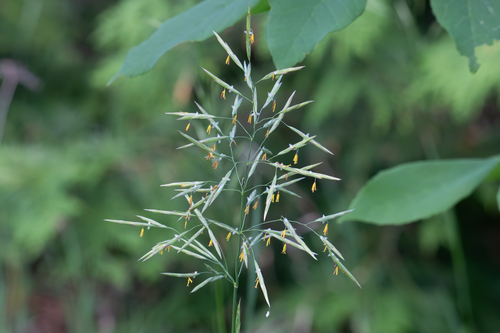
Smooth Brome
Bromus inermis
A hardy and persistent perennial, Smooth Brome is easily identified by a unique 'W' mark on its leaves. While beautiful in the breeze, this invasive grass is a master of the underground, using deep roots to claim territory in backyards across North America.
Quick Identification
Size
Stands 15 to 40 inches (38 to 100 cm) tall; leaves are 4 to 10 inches (10 to 25 cm) long.
Colors
Cool-toned deep green to grey-green foliage; seed heads mature to a purplish-brown or bronze hue.
Key Features
- Distinct 'W' or 'M' shaped watermark across the middle of the leaf blade
- Closed leaf sheaths that form a continuous tube around the stem
- Extensive underground rhizome system that creates thick sod
- Large, loose panicle seed heads with awnless spikelets
When You’ll See Them
Behavior
Smooth Brome is a highly successful, cool-season perennial grass known for its aggressive spreading capabilities. Unlike many bunchgrasses, it utilizes an extensive network of underground rhizomes to form a dense, carpet-like sod. This allows it to outcompete native vegetation, often creating monocultures in meadows and backyard edges where it was once introduced for erosion control.
As it grows, it provides early-season cover for ground-nesting insects and small mammals, though its invasive nature can eventually reduce local biodiversity. It is particularly responsive to nitrogen-rich soils and is one of the first grasses to 'green up' in the spring, taking advantage of early moisture and sunlight before native species emerge from dormancy.
EverydayEarth exclusive
Camera Tips
Capturing the fine details of Smooth Brome requires a camera capable of high-resolution macro shots or a well-placed trail camera focused on the middle of the plant. To help your AI camera correctly identify this species, aim the lens at a single leaf blade where the sunlight can highlight the iconic 'W' or 'M' watermark. This indentation is the primary diagnostic feature and is most visible during the bright midday hours when overhead shadows define the texture of the leaf.
Because this grass grows in dense stands, placing your camera at a low 'frog’s eye' view—about 12 inches off the ground—provides a dramatic perspective of the seed heads against the sky. If you are using an AI-powered camera to monitor wildlife in a patch of brome, keep in mind that the tall, flexible stems are prone to 'false triggers' on windy days. Adjust your PIR sensitivity to medium and set the detection zone away from the top of the grass canopy to avoid filling your SD card with videos of blowing stalks.
In late spring and early summer, focus your camera on the panicles (the flowering tops). This is the best time to document the color transition from green to purple-bronze. If you want to see who is visiting the brome, set your camera for a 3-shot burst; you’ll often catch small birds like Goldfinches or Sparrows perching on the sturdy stems to feed on the ripening seeds in mid-summer. For the best lighting, use the golden hour just before sunset to capture the translucent quality of the seed husks.
Similar Species
Species that look similar or are commonly confused with Smooth Brome.
Frequently Asked Questions
Record Smooth Brome at your habitat
Connect a camera to start building your own species record — AI identifies every visitor automatically.