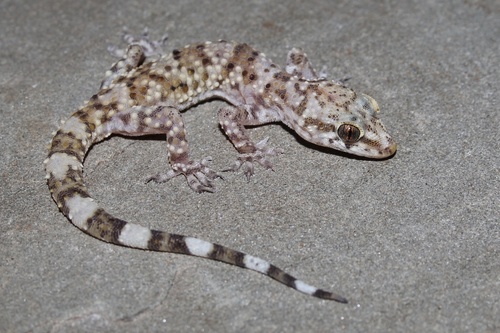
Mediterranean House Gecko
Hemidactylus turcicus
A nocturnal acrobat that turns suburban walls into hunting grounds. Meet the Mediterranean House Gecko, the vocal 'Moon Lizard' that thrives in the glow of our porch lights.
Quick Identification
Size
4 to 5 inches (10 to 13 cm) in total length; weighs approximately 3 to 5 grams
Colors
Translucent tan, peach, or pearly white skin with dark brown or black mottling; creamy white or pale yellow underside
Key Features
- Prominent, lidless eyes with vertical pupils
- Pointed snout and distinctively 'warty' skin covered in small bumps (tubercles)
- Wide toe pads with specialized lamellae for climbing smooth surfaces
- Pale, nearly translucent appearance often appearing pinkish under light
When You’ll See Them
Geographic range
Where Does the Mediterranean House Gecko Live?
Originally native to the Mediterranean Basin, including Southern Europe, North Africa, and parts of the Middle East, this resilient lizard has become one of the most successful hitchhikers in the animal kingdom. It has established vast naturalized populations across the Southern and Southeastern United States, from Florida to California, as well as throughout the Caribbean, Mexico, and Central America. Because they frequently hide in shipped goods and potted plants, they continue to expand their footprint into almost any warm, urbanized region worldwide.
Basemap © OpenStreetMap contributors
Behavior
The Mediterranean House Gecko is a nocturnal specialist, often called the 'Moon Lizard' because it emerges only after the sun sets. Unlike many other reptiles that avoid human contact, these geckos are highly synanthropic, meaning they thrive in human-disturbed environments. They are frequently seen congregating near porch lights and windows, where they wait in ambush for insects attracted to the glow. They are surprisingly vocal for small lizards, producing a series of sharp, bird-like chirps or clicks to defend their territory or attract mates.
These geckos are masters of vertical movement, using microscopic hairs on their toe pads to scramble up glass panes and across ceilings with ease. While they are territorial with other geckos, they are completely harmless to humans and are often welcomed by homeowners as a natural form of pest control. When threatened, they are capable of dropping their tails (autotomy) to distract predators, later regrowing a slightly thicker, darker version of the original tail.
EverydayEarth exclusive
Camera Tips
To capture high-quality footage of Mediterranean House Geckos, focus your camera efforts on vertical surfaces near outdoor light sources. Porch lights, sconces, and illuminated windows are natural magnets for these geckos because they serve as 'buffets' for the insects the lizards hunt. Position your camera 3 to 5 feet away from a wall where you have previously spotted movement, angling it slightly upward to catch the gecko's pale underside and textured skin.
Since these geckos are small and move in quick bursts, set your AI-powered camera to its highest motion sensitivity. Because they are nocturnal, infrared (IR) night vision is essential, but if your camera has a 'starlight' or color night vision mode, the gecko's translucent skin and dark spots will show up with incredible detail against the dark background of a house wall. Avoid using heavy flashes which can startle the gecko and cause it to retreat into a crevice for the rest of the night.
If you aren't seeing them near lights, try placing your camera near 'entry points' such as shutters, siding gaps, or stacked firewood. In colder months, they may be less active, so look for them on warm nights following a sunny day. Time-lapse mode can also be a fascinating way to watch their territorial displays, as males will often perform 'push-ups' and tail-waving motions when another gecko enters their hunting ground.
Similar Species
Species that look similar or are commonly confused with Mediterranean House Gecko.
Frequently Asked Questions
Record Mediterranean House Gecko at your habitat
Connect a camera to start building your own species record — AI identifies every visitor automatically.