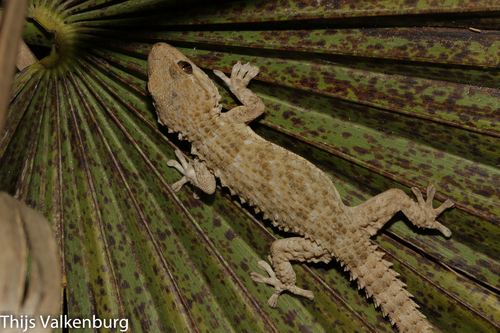
Moorish Gecko
Tarentola mauritanica
Meet the 'Common Wall Gecko,' a spiny-skinned night hunter that has lived alongside humans for centuries. Famous for its ability to walk on ceilings, this resilient reptile is the ultimate backyard insect controller.
Quick Identification
Size
Total length up to 15 cm (6 inches); snout-to-vent length typically 6-8 cm (2.4-3.1 inches)
Colors
Brownish-grey or sandy-grey with darker blotches; pale cream underside; eyes are golden-grey with vertical pupils
Key Features
- Prominent cone-shaped spiny tubercles across the back and tail
- Broad, flattened triangular head with large eyes
- Wide toe pads with claws present only on the 3rd and 4th digits
When You’ll See Them
Geographic range
Where Does the Moorish Gecko Live?
Originally native to the Mediterranean Basin, including North Africa and Southern Europe, the Moorish Gecko is a successful colonizer that has spread far beyond its ancestral home. It is most abundant in coastal regions of Spain, Portugal, Italy, Greece, and Morocco, where it is a staple of the local backyard wildlife. In recent decades, it has established thriving introduced populations in the Americas, particularly in California and Florida in the United States, as well as parts of Argentina and Uruguay, proving its ability to thrive in any warm, Mediterranean-style climate.
Basemap © OpenStreetMap contributors
Behavior
The Moorish Gecko is a robust and highly adaptable reptile, primarily known for its nocturnal lifestyle and its remarkable ability to navigate vertical surfaces. In urban and suburban environments, it has become a master of the night, frequently observed perched near outdoor light fixtures where it waits in ambush for insects attracted to the glow. While they are most active after dark, they are often seen during the day basking in the sun near their crevices to regulate their body temperature, especially in the cooler spring and autumn months.
This species is notably territorial and can be quite vocal for a lizard, producing soft clicking or squeaking noises during social encounters or when defending a prime hunting spot. Unlike many skittish lizard species, the Moorish Gecko has a long history of synanthropy—living alongside humans—and is generally bold, often remaining stationary on a wall even when a human passes nearby. Their specialized toe pads, covered in millions of microscopic hairs called setae, allow them to run across smooth glass and even hang upside down from ceilings with ease.
EverydayEarth exclusive
Camera Tips
To capture high-quality footage of a Moorish Gecko, focus your camera on vertical surfaces near artificial light sources. Stone walls, brick siding, or the areas immediately surrounding porch lights and garden lamps are prime hunting grounds. Position the camera about 5 to 6 feet (1.5–1.8 meters) off the ground, angled slightly downward or parallel to the wall surface. This perspective allows you to catch the gecko’s unique 'ambush' posture as it waits for passing insects.
Because these geckos are strictly nocturnal hunters, your camera’s infrared (IR) performance is critical. Ensure your camera is placed close enough to the wall (within 3-5 feet) so the IR flash illuminates the gecko without blowing out the highlights on its pale underside. Since they are relatively small, set your camera's motion sensitivity to 'High' and choose a short trigger speed to capture them as they dart across the field of view. If your camera has a 'Macro' or close-focus setting, be sure to enable it.
You can effectively 'bait' a camera location by simply leaving an outdoor light on. This creates a natural buffet of moths and flies that will keep the gecko returning to the same spot night after night. Avoid using chemical pesticides in your garden, as a healthy insect population is the best way to ensure these geckos stay resident. During the day, you can also look for them basking in the sun near deep crevices; a time-lapse setting during the afternoon can capture their subtle movements as they track the warmth of the sun before their nightly hunt begins.
Similar Species
Species that look similar or are commonly confused with Moorish Gecko.
Frequently Asked Questions
Record Moorish Gecko at your habitat
Connect a camera to start building your own species record — AI identifies every visitor automatically.