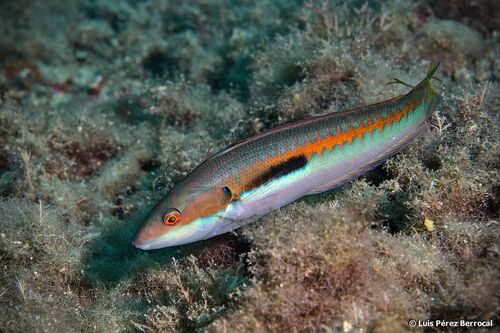
Mediterranean Rainbow Wrasse
Coris julis
A dazzling jewel of the shallows, the Mediterranean Rainbow Wrasse is famous for its striking orange zigzags and remarkable ability to change its gender and color as it matures.
Quick Identification
Size
Typically 15-20 cm (6-8 inches), reaching a maximum length of 25 cm (10 inches).
Colors
Females and juveniles are brownish-yellow with a white belly and a dark horizontal stripe. Secondary males are vibrant with a jagged orange lateral stripe, a blue-black spot behind the pectoral fin, and a greenish-blue back.
Key Features
- Vibrant orange zigzag stripe along the flank (males)
- Small black spot at the base of the dorsal fin
- Slender, elongated cigar-shaped body
- Continuous dorsal fin spanning most of the back
- Primary individuals show a distinct white underside
When You’ll See Them
Geographic range
Where Does the Mediterranean Rainbow Wrasse Live?
The Mediterranean Rainbow Wrasse is native to the warm temperate waters of the Eastern Atlantic Ocean and is ubiquitous throughout the Mediterranean Sea. Its range extends from the southern coast of Norway and the British Isles southward to Senegal, including the oceanic islands of the Azores, Madeira, and the Canaries. Within these regions, it is most frequently found in the sunlit 'photic zone' where rocky substrates and seagrass provide ample cover and food.
Basemap © OpenStreetMap contributors
Behavior
The Mediterranean Rainbow Wrasse is a highly active and inquisitive diurnal fish. During the day, they are constantly on the move, darting between rocks and through seagrass leaves in search of food. They are well-known among divers and snorkelers for their lack of fear; they often follow larger animals or humans that disturb the seabed, hoping to snatch up small invertebrates uncovered in the wake. This boldness makes them excellent subjects for underwater observation.
As night falls, the Rainbow Wrasse exhibits a unique survival strategy by burying itself in the sandy substrate. Using powerful undulations of its body, it disappears beneath the sand to sleep, protected from nocturnal predators. They also utilize this 'sand-diving' behavior if they feel particularly threatened during the day. They are protogynous hermaphrodites, meaning they begin life as females and can later transform into more colorful, larger 'secondary' males.
EverydayEarth exclusive
Camera Tips
To capture the Mediterranean Rainbow Wrasse on an underwater backyard or dock camera, placement is everything. Position your camera near the edge of a rocky reef where it meets a sandy patch or within a seagrass meadow. These are the fish's primary hunting grounds. Aim the lens slightly downward to capture their bottom-feeding behavior, and try to utilize natural sunlight by keeping the camera in shallow water (less than 5 meters deep) to ensure their iridescent colors pop without the need for artificial filters.
You can encourage them to visit your camera's field of view by slightly disturbing the sand or turning over a small, algae-covered rock nearby (ensure this is done ethically and legally in your area). The movement and the potential for exposed prey will quickly attract the curious Rainbow Wrasse. If using a baited camera trap, a small mesh bag containing crushed mussels or shrimp works exceptionally well as a lure.
Since these fish are very fast, use a high frame rate setting (60fps or higher) to avoid motion blur. Because they bury themselves at night, your best footage will always occur during full daylight. During the summer months, they move into shallower water to spawn, providing the best opportunities for high-density group shots near the shoreline.
Similar Species
Species that look similar or are commonly confused with Mediterranean Rainbow Wrasse.
Ornate Wrasse
The Ornate Wrasse has a more vertical green and red barred pattern and lacks the male Rainbow Wrasse's distinctive orange zigzag stripe.
Five-spotted Wrasse
This species has a deeper body shape and a dark spot at the base of the tail, whereas the Rainbow Wrasse is much more slender and cigar-shaped.
Frequently Asked Questions
Record Mediterranean Rainbow Wrasse at your habitat
Connect a camera to start building your own species record — AI identifies every visitor automatically.