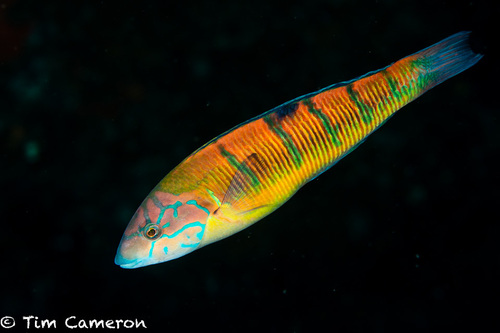
Ornate Wrasse
Thalassoma pavo
Meet the 'Circus Fish' of the Mediterranean, a dazzling display of neon greens and vibrant reds. The Ornate Wrasse brings a tropical explosion of color to rocky coastlines and sun-drenched reefs.
Quick Identification
Size
Typically 15-25 cm (6-10 inches) in length; weight usually under 300g (0.6 lbs).
Colors
Highly vibrant; females and juveniles are green-brown with dark vertical bars, while terminal males are bright green or turquoise with a red-streaked head and a prominent vertical blue-black band behind the pectoral fin.
Key Features
- Slender, cigar-shaped body
- Lyre-shaped tail fin in mature adults
- Intricate blue and red facial markings
- Single prominent dark vertical bar behind the gills in males
When You’ll See Them
Sightings on EverydayEarth
Jun 23, 2026
A vibrant scene within a giant kelp forest where several bright orange Garibaldi are swimming among the swaying fronds. A mottled Kelp Bass moves across the center of the frame, while smaller, slender Señoritas and dark, oval Blacksmith fish navigate the water column in the background.
Apr 4, 2026
The footage captures a bustling underwater scene within a California kelp forest. Initially, the water is somewhat murky as several fish, including Kelp Bass and a slender Ornate Wrasse, swim near the swaying kelp. The scene then transitions to a much more brightly lit area where the sun filters through the amber kelp canopy. In this clearer water, a bright orange Garibaldi is visible in the background, and a California Sheephead, identifiable by its dark scales and white chin, swims through the lower portion of the frame.
Mar 24, 2026
A vibrant underwater scene shows several fish species navigating a thick kelp forest. A bright orange Garibaldi swims close to the camera at the start, followed by slender Ornate Wrasse darting through the fronds. Later, two dark, oval-shaped Halfmoon fish swim calmly across the middle ground, while the amber-colored kelp sways rhythmically in the current.
Mar 12, 2026
A diverse group of temperate reef fish are swimming through a dense kelp forest. Several Garibaldi are foraging near the kelp fronds, while California Sheephead and slender Senorita fish move through the background and foreground. The fish appear to be calmly navigating the underwater environment.
Behavior
The Ornate Wrasse is a highly energetic and inquisitive fish, often referred to as the 'circus fish' due to its bright colors and erratic, playful swimming style. They are diurnal, meaning they are active during the day and retreat into rocky crevices or bury themselves in the sand at night to sleep. They are frequently seen following larger predators or even human divers, hoping to snatch up small invertebrates stirred up from the seabed.
Socially, these fish exhibit a fascinating harem-based structure. A single large, brightly colored 'terminal' male defends a territory and a group of females. Interestingly, the Ornate Wrasse is a protogynous hermaphrodite; if the dominant male is removed from the population, the largest female in the group can undergo a biological transformation to become a male, changing both her physical appearance and behavior to take over the territory.
EverydayEarth exclusive
Camera Tips
Capturing the Ornate Wrasse requires an underwater camera setup, such as a waterproof action camera or a specialized housing. For the best results, place your camera in shallow water (1-3 meters deep) near rocky outcroppings or jetties where the fish naturally congregate to forage. Use a weighted tripod or a lead-weighted base to keep the camera stationary against the surge of the waves. Position the camera facing a flat rock surface or a small crevice, as these are natural 'stages' where the wrasse will stop to inspect for food.
Lighting is the most critical factor for showcasing this species' incredible colors. Aim to film during the middle of the day when the sun is directly overhead; this allows light to penetrate the water column and illuminate the iridescent greens and reds that might otherwise look dull at depth. If your camera allows for manual settings, use a fast shutter speed to freeze their quick, darting movements. Setting the white balance to 'underwater' or using a light red filter can help correct the blue cast typical of Mediterranean waters, making the red markings on the wrasse pop.
To draw the Ornate Wrasse into the frame, you can use a small amount of bait, such as a crushed sea urchin or a piece of shrimp tucked into a rock crevice directly in front of the lens. They are incredibly curious and will often be the first fish to investigate a new object in their environment. Avoid areas with heavy silt or sand that can be kicked up by the current, as 'backscatter' can confuse AI motion detection and lower the quality of your footage. Instead, look for clear water with high visibility during a calm sea state.
Similar Species
Species that look similar or are commonly confused with Ornate Wrasse.
Frequently Asked Questions
Record Ornate Wrasse at your habitat
Connect a camera to start building your own species record — AI identifies every visitor automatically.