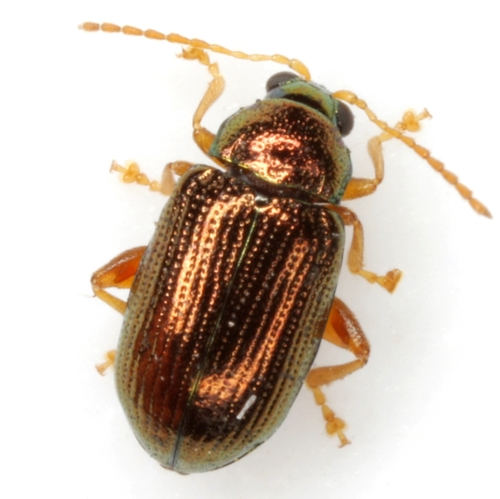
Metallic Brown Flea Beetle
Crepidodera browni
The Metallic Brown Flea Beetle is a shimmering, coppery gymnast of the insect world. Though no larger than a grain of rice, its brilliant metallic armor and incredible jumping power make it a fascinating find for any backyard explorer.
Quick Identification
Size
2.0–3.5 mm (0.08–0.14 inches) in length
Colors
Brilliant metallic bronze, copper, or brownish-gold; legs and antennae can be slightly lighter reddish-brown.
Key Features
- Enlarged hind femurs (thighs) modified for jumping
- Deeply pitted or punctuated elytra (wing covers)
- Uniform metallic bronze sheen across the pronotum and wings
- Found almost exclusively on willow or poplar foliage
When You’ll See Them
Geographic range
Where Does the Metallic Brown Flea Beetle Live?
The Metallic Brown Flea Beetle is native to the North American continent, where it maintains a robust presence across a variety of temperate landscapes. Its core range extends from the southern reaches of Canada across the majority of the United States, thriving in nearly every state where its host willow trees are found. Because it follows the distribution of the Salicaceae family, it is most frequently encountered in moist environments from the Atlantic coast to the Pacific Northwest.
Basemap © OpenStreetMap contributors
Behavior
The Metallic Brown Flea Beetle is a highly active and agile herbivore. It earns the name 'flea beetle' due to its specialized hind legs, which contain a powerful muscle known as the metafemoral spring. When threatened by a predator or a curious human, the beetle can launch itself several feet into the air—a massive distance relative to its microscopic size—making it difficult to track with the naked eye.
When not performing aerial escapes, these beetles are dedicated foragers. They spend the daylight hours crawling across the surfaces of leaves, using their mandibles to scrape away plant tissue. While they are generally solitary, they can congregate in large numbers on a single host tree during the height of summer, creating a shimmering effect as the sun reflects off their metallic bodies. They are completely harmless to humans, lacking any sting or bite.
EverydayEarth exclusive
Camera Tips
Capturing a high-quality image of the Metallic Brown Flea Beetle requires a specialized approach because of its tiny size. Standard trail cameras usually lack the focal depth for insects this small, so you will need to utilize a camera with a dedicated macro lens or a 'near-focus' setting. Position your camera just 3 to 6 inches away from a cluster of willow leaves, specifically targeting areas that show signs of 'shothole' feeding—small, circular holes eaten through the leaf.
Lighting is the most critical factor for this species. To capture the brilliant metallic bronze of the Crepidodera browni, set up your camera in a spot where it receives direct but diffused sunlight. The late morning sun is ideal, as it illuminates the beetle's reflective exoskeleton without creating the harsh glares that can wash out a photo. Use a high shutter speed if possible, as these beetles move quickly and can jump in a fraction of a second if the wind shakes the branch.
For the best results, mount your camera on a stable tripod or a clamp rather than a moving branch to avoid motion blur. You don't need any artificial lures; the willow tree itself is the bait. Look for 'weeping' willows near water sources, as these are the preferred habitats. Check your camera during mid-summer when temperatures are consistently above 70°F (21°C), as this is when the beetles are most active on the upper surfaces of the leaves.
Similar Species
Species that look similar or are commonly confused with Metallic Brown Flea Beetle.
Frequently Asked Questions
Record Metallic Brown Flea Beetle at your habitat
Connect a camera to start building your own species record — AI identifies every visitor automatically.