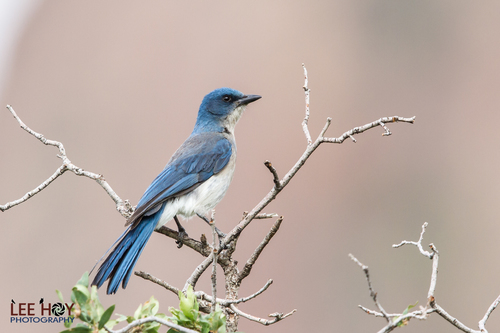
Mexican Jay
Aphelocoma wollweberi
Meet the Mexican Jay, the social architect of the southwestern mountains. Known for their complex family lives and striking azure feathers, these intelligent birds bring a burst of color and character to any backyard camera.
Quick Identification
Size
Length 28-32 cm (11-12.5 in); Wingspan approx 43 cm (17 in); Weight 105-144g (3.7-5.1 oz)
Colors
Dull blue upperparts, wings, and tail; pale gray-white underparts; dark bill and legs; no significant difference between males and females
Key Features
- Unstreaked pale gray throat and breast
- Large, heavy black bill
- Social, often seen in groups of 5-25 birds
- Deep blue upperparts without a crest
When You’ll See Them
Sightings on EverydayEarth
Jun 23, 2026
A group of Mexican Jays congregates at the feeding station. One individual is perched on the suet feeder, actively feeding, while several others arrive on the lower platform and ground below to forage. The birds exhibit their typical social behavior, landing and moving in coordination.
Jun 22, 2026
Several White-winged Doves are visiting the feeder; one is perched directly on the suet cage while another lands on the lower platform. A pair of Mexican Jays is also visible on the upper left branch of the feeder structure, with one moving between branches before flying off.
Jun 20, 2026
Two Band-tailed Pigeons are visiting the feeder station; one perches directly on top of the suet cage to feed while another searches for seeds on the ground below. To the left, a Mexican Jay perches on a branch, observing the area before briefly flicking its tail.
Jun 19, 2026
A Mexican Jay perches quietly on the upper left branch of the feeder structure. Below it, two White-winged Doves are busy at the suet cage, while a third dove walks along the bottom tray platform looking for fallen seeds. The scene is brightly lit with morning sunlight filtering through the surrounding trees.
Jun 18, 2026
A Mexican Jay lands on the lower left edge of the rustic bird feeder. It spends several seconds looking around and adjusting its position on the wooden platform before beginning to search for food.
Jun 18, 2026
A Mexican Jay perches briefly on the suet feeder before departing. Meanwhile, several White-winged Doves forage on the platform below, with one bird flying up to land on the top of the feeder log to investigate the suet.
Geographic range
Where Does the Mexican Jay Live?
The Mexican Jay is a permanent resident of North America, primarily found in the rugged mountain ranges of the Southwestern United States and Mexico. Its territory extends from the mountains of central Arizona, New Mexico, and western Texas southward through the Sierra Madre Oriental and Occidental. While they are non-migratory, they are masters of their high-altitude domain, rarely descending to low deserts unless food sources in the pine-oak belt fail.
Basemap © OpenStreetMap contributors
Behavior
Mexican Jays are remarkably social birds, living in permanent, stable flocks that can include up to 25 individuals. Unlike many other bird species, they practice cooperative breeding, where younger birds or non-breeding adults help the dominant pairs raise their chicks by providing food and protection. This creates a lively, high-energy environment that is fascinating to observe, as the birds are constantly communicating through a series of harsh calls and subtle social displays.
These jays are highly intelligent and possess a complex spatial memory, which they use to cache thousands of acorns and pine nuts each year. They are bold around humans and often become the dominant presence at backyard feeders in their range. Their social structure is so rigid that individuals rarely leave their natal group, leading to long-term family bonds that are quite rare in the avian world.
EverydayEarth exclusive
Camera Tips
To capture the social dynamics of Mexican Jays, place your camera near a large platform feeder or a flat, elevated rock. Unlike smaller songbirds, these jays prefer wide landing zones where they can land comfortably and survey their surroundings. Position the camera at chest height (about 4-5 feet) and use a wide-angle lens setting if available, as you will often have three or four birds appearing in the frame simultaneously.
Whole, unsalted peanuts in the shell are the absolute best lure for this species. Watching a Mexican Jay weigh two different peanuts in its bill to find the heaviest one is a classic behavior that makes for great video content. Suet blocks and large sunflower seeds will also keep them coming back. If you live in an arid region, a birdbath with a small dripper or fountain will be an irresistible magnet for the whole flock.
Set your camera to take short video clips (15-20 seconds) rather than just still photos. The most interesting aspect of Mexican Jays is their vocalization and social interaction; a video captures their 'chook-chook-chook' calls and the way they nudge each other aside at the feeder. During the autumn, focus your camera on the ground near the base of oak trees to capture their caching behavior as they bury acorns for the winter.
Because they are active early in the morning, ensure your camera has good low-light performance or is positioned to catch the first rays of the sun. Avoid placing the camera in deep shade under a heavy canopy, as their blue plumage can look dull or gray without sufficient light. In the winter months, these birds become even bolder, making it the perfect time to get close-up 'portrait' shots by placing the camera within 2-3 feet of a feeding station.
Similar Species
Species that look similar or are commonly confused with Mexican Jay.
Woodhouse's Scrub-Jay
Has a distinctly streaked white throat and a partial blue 'necklace' across the breast, whereas the Mexican Jay's throat is plain gray.
Steller's Jay
Features a prominent dark crest on the head and much darker, sootier-black plumage on the upper body compared to the crestless, blue-and-gray Mexican Jay.
Frequently Asked Questions
Record Mexican Jay at your habitat
Connect a camera to start building your own species record — AI identifies every visitor automatically.