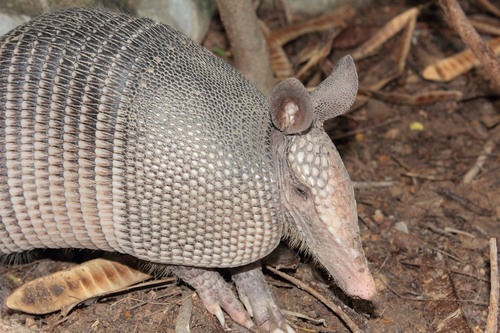
Mexican Long-nosed Armadillo
Dasypus mexicanus
The most widespread armored mammal in North America, the Mexican Long-nosed Armadillo is a persistent digger known for its unique 'armor' and its surprising ability to leap into the air when surprised.
Quick Identification
Size
Body length 38-58 cm (15-23 in), tail length 25-45 cm (10-18 in); weighs 2.5-6.5 kg (5.5-14 lbs)
Colors
Grayish-brown to brownish-black bony armor; underside is pale pinkish-gray with sparse hair; yellowish-white scales on the lower sides.
Key Features
- Hard carapace with 7-11 (usually 9) movable bands
- Elongated, tapered snout with sensitive nostrils
- Large, leathery, pointed ears
- Strong claws specialized for digging and burrowing
When You’ll See Them
Geographic range
Where Does the Mexican Long-nosed Armadillo Live?
Native to North and Central America, the Mexican Long-nosed Armadillo is the primary armadillo species found across Mexico and much of the Southern United States. Its range is currently expanding northward and eastward, reaching as far as Nebraska and the Atlantic coast, fueled by its adaptability to human-altered landscapes. While they thrive in the subtropical regions of Central America, they are increasingly common sights in the temperate forests and grasslands of the American South.
Basemap © OpenStreetMap contributors
Behavior
The Mexican Long-nosed Armadillo is a solitary and primarily nocturnal creature, though it may emerge during the day in cooler weather or under heavy cloud cover. They are famously known for their 'armadillo shuffle'—a rhythmic, noisy foraging style where they root through leaf litter with their noses, oblivious to their surroundings. Despite their heavy armor, they are surprisingly agile, capable of a sudden vertical leap when startled and possessing the ability to swim or even walk underwater across small streams by holding their breath.
These mammals are excellent excavators, maintaining multiple burrows throughout their home range for sleeping and escaping predators. While generally shy and non-aggressive toward humans, they can become quite habituated to suburban environments, often turning over mulch and lawns in search of grubs. Their social interactions are limited mostly to the breeding season, though they are famous for giving birth to genetically identical quadruplets derived from a single egg.
EverydayEarth exclusive
Camera Tips
To capture high-quality footage of these armored wanderers, camera placement is everything. Set your camera very low to the ground—no more than 6 to 10 inches high. Armadillos spend almost all their time with their noses pressed into the dirt, so a high-angle shot will only show you the top of their shell. Aim your lens along garden edges, fence lines, or established 'game trails' through tall grass where you see signs of fresh digging or 'V-shaped' foraging holes.
While they aren't easily lured by traditional food baits like many mammals, you can attract them by creating a 'soft spot.' Turn over a small patch of soil or mulch and dampen it with water; the scent of moist earth and the easy access to worms and grubs is often irresistible to a passing armadillo. Because they move with a constant, jerky motion while foraging, use a fast trigger speed and set your camera to take short video clips (10-15 seconds) rather than still photos to better capture their unique behaviors.
Nighttime performance is critical since these animals are strictly nocturnal in many regions. Ensure your camera has a strong infrared flash that doesn't 'white out' the reflective scales of their armor at close range. If you find a burrow entrance, place the camera 5-8 feet away facing the opening; armadillos are creatures of habit and will likely exit and enter at the same time each evening, providing the perfect opportunity for a clear, head-on shot.
Similar Species
Species that look similar or are commonly confused with Mexican Long-nosed Armadillo.
Frequently Asked Questions
Record Mexican Long-nosed Armadillo at your habitat
Connect a camera to start building your own species record — AI identifies every visitor automatically.