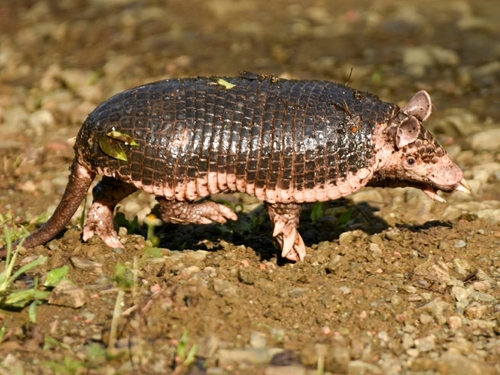
Northern Naked-tailed Armadillo
Cabassous centralis
The Northern Naked-tailed Armadillo is a ghost of the tropical forest floor, recognized by its unique scale-less tail and incredible digging prowess. This elusive insectivore is a prize find for any backyard camera enthusiast in Central America.
Quick Identification
Size
Total length of 30–49 cm (12–19 in) and weighing between 2–3.5 kg (4.4–7.7 lbs).
Colors
Dark brownish-grey to blackish carapace with a paler, flesh-colored or yellowish-white underside; skin on the tail is pinkish or grey.
Key Features
- Tail entirely lacks bony scutes or scales
- 10–13 movable bands on the midsection
- Large, sickle-shaped claws on the front feet
- Squat, powerful build with short legs
When You’ll See Them
Geographic range
Where Does the Northern Naked-tailed Armadillo Live?
The Northern Naked-tailed Armadillo is native to the Neotropical realm, spanning from southern Mexico through Central America into northwestern South America. Its core range includes countries such as Belize, Guatemala, Costa Rica, and Panama, extending as far south as the Andean regions of Colombia, Venezuela, and Ecuador. Unlike its cousin the Nine-banded Armadillo, it has not expanded its range into the United States and remains a specialist of tropical and subtropical latitudes.
Basemap © OpenStreetMap contributors
Behavior
The Northern Naked-tailed Armadillo is a reclusive, fossorial (burrowing) mammal that spends a significant portion of its life underground. Unlike the more common Nine-banded Armadillo, this species is strictly nocturnal and rarely seen above ground during daylight hours. They are powerful excavators, using their oversized front claws to tear into termite mounds or dig deep, intricate burrows in well-drained soil.
When foraging, they move with a frantic, zig-zagging gait, pressing their snouts into the leaf litter to sniff out prey. They are generally solitary and highly sensitive to vibrations; at the slightest sign of a predator or human presence, they will quickly retreat into a burrow or attempt to bury themselves on the spot. Because of their secretive nature and low population density, they are considered one of the most difficult mammals to observe in the wild.
EverydayEarth exclusive
Camera Tips
Capturing a Northern Naked-tailed Armadillo on camera requires patience and strategic placement, as they do not follow predictable trails like larger mammals. The most effective strategy is to locate fresh diggings—look for small, conical holes in the soil or partially demolished termite mounds. Place your camera roughly 12 inches (30 cm) off the ground, angled slightly downward to focus on the area directly in front of a suspected burrow entrance or active feeding site.
Since these armadillos are strictly nocturnal, a camera with a high-quality infrared flash is essential. White flash can sometimes startle them into retreating, while a 'no-glow' or 'low-glow' IR setup will allow you to capture natural behavior without scaring the animal away. Set your camera to take short video clips (10-15 seconds) rather than just photos; their movement is often quick and jerky, and video provides a much better chance of seeing the distinctive 'naked' tail that confirms the species ID.
Avoid placing cameras near heavy human foot traffic or loud machinery, as this species is particularly sensitive to ground vibrations. If you are monitoring a backyard or private forest patch, focus on areas with soft, loamy soil and plenty of leaf litter, which are prime foraging grounds. While they aren't traditionally attracted to food baits, some researchers have had success placing cameras near large, active ant colonies where the armadillo is likely to return for a repeat meal.
Similar Species
Species that look similar or are commonly confused with Northern Naked-tailed Armadillo.
Frequently Asked Questions
Record Northern Naked-tailed Armadillo at your habitat
Connect a camera to start building your own species record — AI identifies every visitor automatically.