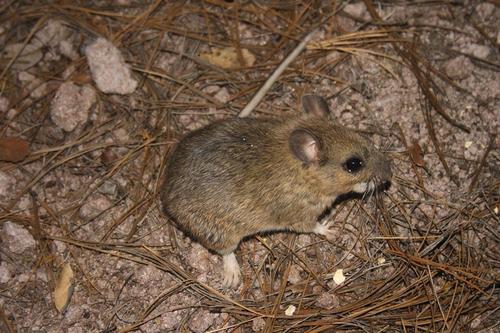
Mexican Woodrat
Neotoma mexicana
The ultimate collector of the animal kingdom, the Mexican Woodrat is a nocturnal architect that builds complex dens in rocky terrain. Watch as this agile 'pack rat' scours the night for seeds and treasures to bring back to its mountain fortress.
Quick Identification
Size
Total length of 11.4-15.7 inches (29-40 cm); weight of 5-10.5 oz (140-300 g)
Colors
Grayish-brown to cinnamon-buff upper body with a starkly white underside and white paws; bicolored tail is dark gray above and white below.
Key Features
- Large, rounded ears with fine hair
- Distinctly bicolored tail shorter than the head and body
- White-furred feet and underbelly
- Large, dark eyes adapted for night vision
When You’ll See Them
Geographic range
Where Does the Mexican Woodrat Live?
The Mexican Woodrat is a native resident of North and Central America, thriving in the rugged landscapes of the interior Western United States. Its core range extends from the rocky highlands of Utah and Colorado through New Mexico and Arizona, reaching deep into the various mountain ranges of Mexico. Further south, established populations can be found in the high-elevation forests of Guatemala, El Salvador, and parts of Honduras, making it a true specialist of the American cordillera.
Basemap © OpenStreetMap contributors
Behavior
The Mexican Woodrat is a primarily nocturnal architect, famous for its 'pack rat' habit of collecting shiny objects, sticks, and debris to build elaborate dens known as middens. Unlike common city rats, these woodrats are relatively solitary and exceptionally clean, often creating specific chambers within their middens for sleeping, food storage, and waste. They are agile climbers, navigating steep rock faces and tree branches with ease to find the best foraging spots.
While they are shy and rarely seen during the day, they are quite active after dark. They don't typically seek out human interaction, but if your backyard borders a rocky canyon or woodland, they might investigate your porch for interesting 'treasures' to add to their collection. They communicate through a series of chirps and squeaks, though they are generally quiet to avoid detection by owls and coyotes.
EverydayEarth exclusive
Camera Tips
To capture the Mexican Woodrat, focus your camera on rocky transitions. Look for 'middens'—messy-looking piles of sticks, dried cactus, and debris tucked into rock crevices or under fallen logs. Position your camera about 12-18 inches off the ground, angled slightly downward toward the entrance of these structures. Because they are strictly nocturnal, a camera with high-quality infrared (no-glow) LEDs is essential to avoid startling them and to get clear black-and-white nighttime footage.
Baiting can be very effective for woodrats. A small smear of peanut butter on a rock or a handful of sunflower seeds placed in front of the camera will often cause them to pause long enough for a high-quality capture. Since they are attracted to 'treasures,' some enthusiasts even place a shiny object like a silver coin or a bright bottle cap in the frame; the woodrat may stop to inspect or even attempt to carry the item away, providing a classic 'pack rat' video sequence.
Set your camera to 'Video Mode' with a 15-20 second duration. Woodrats are active and twitchy, so a still photo might only catch a blur of a tail. Video allows you to observe their dexterous climbing and hoarding behaviors. If you are placing the camera in a rocky area, ensure it is securely strapped or weighted down, as these curious rodents have been known to tug on loose straps or equipment during their nightly patrols.
Similar Species
Species that look similar or are commonly confused with Mexican Woodrat.
White-throated Woodrat
Very similar, but the White-throated Woodrat has hairs at the base of its throat that are white all the way to the skin, whereas the Mexican Woodrat's throat hairs are gray at the base.
Bushy-tailed Woodrat
Easily distinguished by its large, squirrel-like bushy tail, compared to the Mexican Woodrat's more traditional, short-haired rat tail.
Frequently Asked Questions
Record Mexican Woodrat at your habitat
Connect a camera to start building your own species record — AI identifies every visitor automatically.