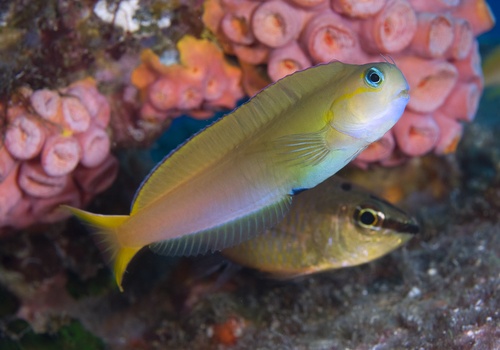
Midas Combtooth Blenny
Ecsenius midas
A shimmering streak of gold in the tropical current, the Midas Combtooth Blenny is the reef's most famous social mimic. Watch for its graceful lyretail as it dances among schools of Anthias, blending in perfectly with the crowd.
Quick Identification
Size
Typically grows to 10-13 cm (4-5 inches) in length.
Colors
Brilliant golden-yellow to deep orange body; often features a subtle blue or purple shadow or ring around the eyes and a dark spot near the vent.
Key Features
- Deeply forked lyre-shaped tail
- Elongated, eel-like body profile compared to other blennies
- Constant 'waving' swimming motion
- Large, expressive eyes with blue accents
When You’ll See Them
Geographic range
Where Does the Midas Combtooth Blenny Live?
Native to the vibrant tropical waters of the Indo-Pacific region, the Midas Combtooth Blenny enjoys a vast distribution. Its presence stretches from the Red Sea and the eastern coast of Africa across to the Marquesas Islands, encompassing the waters of the Maldives, Indonesia, and the Great Barrier Reef in Australia. This species is a hallmark of healthy coral ecosystems throughout the Indo-Central Pacific.
Basemap © OpenStreetMap contributors
Behavior
The Midas Combtooth Blenny is a charismatic reef inhabitant known for its unusual social behavior. Unlike most blennies that spend their time perched on rocks or hiding in crevices, the Midas Blenny is a confident swimmer that frequently ventures into the open water column. It is a classic example of a social mimic; it often joins schools of Lyretail Anthias (Pseudanthias squamipinnis), blending in with their similar coloration and shape to reduce its individual risk of predation.
In a reef environment, these fish are semi-territorial but generally peaceful. They claim small holes or abandoned worm tubes as their 'home base,' backing into them tail-first when threatened or when retreating for the night. They exhibit a charming 'bobbing' or 'weaving' swimming style that makes them easily identifiable even from a distance. While they are social with other species, they can be territorial toward other blennies with similar body shapes.
EverydayEarth exclusive
Camera Tips
Capturing the Midas Combtooth Blenny requires an underwater setup, such as a waterproof action camera or a specialized reef-cam housing. Because these fish are planktivores that feed in the current, place your camera near a 'cleaning station' or a coral head where you see schools of orange Anthias gathering. The Midas Blenny will likely be mixed in with them, swimming a few inches above the substrate to catch passing food.
For the best shots, identify their 'bolt hole'—the specific crevice or tube they retreat to when startled. Position your camera on a small tripod or weighted mount about 12-18 inches away from this hole, angled slightly upward to catch the light filtering through the water. Patience is key; once the fish feels the 'predator' (you) has left, it will emerge tail-first and begin its characteristic dancing motion in front of the lens.
High frame rates (60fps or higher) are essential for this species because their swimming motion is fluid and rapid. If you are using an AI-powered underwater camera, set the trigger sensitivity to high, as their slender profile can sometimes be missed against a busy reef background. Mid-day offers the best natural lighting to bring out the brilliant 'Midas' gold and the electric blue highlights around their eyes.
Similar Species
Species that look similar or are commonly confused with Midas Combtooth Blenny.
Frequently Asked Questions
Record Midas Combtooth Blenny at your habitat
Connect a camera to start building your own species record — AI identifies every visitor automatically.