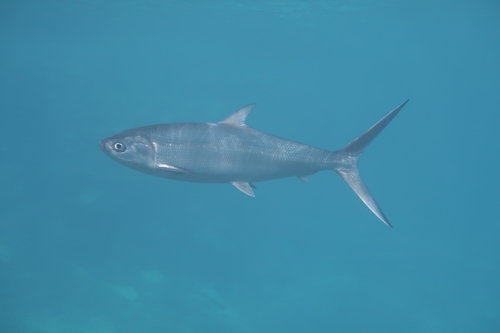
Milkfish
Chanos chanos
The 'national fish of the Philippines,' the milkfish is a silver-scaled marvel of the Indo-Pacific known for its incredible speed and versatility in both salt and fresh water.
Quick Identification
Size
Typically 1 meter (3.3 feet) in length, but can reach up to 1.8 meters (5.9 feet); weights range from 4 to 14 kg (9 to 31 lbs).
Colors
Brilliant silvery-white on the sides and belly, transitioning to olive-green or blue on the back; fins are generally clear or light with dark margins.
Key Features
- Streamlined torpedo-shaped body
- Deeply forked, large caudal (tail) fin
- Small, toothless mouth at the end of the snout
- Single dorsal fin located near the midpoint of the back
When You’ll See Them
Geographic range
Where Does the Milkfish Live?
The milkfish is a quintessential resident of the tropical Indo-Pacific, sprawling across a massive aquatic territory that begins in the Red Sea and stretches across to the Pacific coast of Central America. It is most densely concentrated in the warm waters surrounding the Philippines, Indonesia, and Taiwan, where it thrives in coastal lagoons and estuaries. While they are primarily a marine species, their unique ability to tolerate varying salinity levels allows them to venture into freshwater rivers and mangrove swamps throughout Southeast Asia and Northern Australia.
Basemap © OpenStreetMap contributors
Behavior
Milkfish are highly active and powerful swimmers, known for their ability to leap out of the water when startled or during high-activity feeding periods. They are social, schooling fish that spend much of their adult life in coastal marine environments, though they are euryhaline, meaning they can thrive in varying levels of salinity from full seawater to brackish lagoons and even freshwater rivers.
While they are generally shy and easily spooked by sudden movements, they are quite predictable in their movements, often following the tides into mangrove forests and estuaries to feed. They do not have teeth, so their interaction with the environment is gentle, primarily grazing on the bottom or filtering nutrients from the water column.
EverydayEarth exclusive
Camera Tips
Capturing milkfish on camera requires an underwater setup, such as an AI-powered marine camera or a waterproof action camera mounted on a stable dock piling or submerged reef. Because they are easily startled, the camera should be fixed in place rather than handheld. Position the lens to face a natural clearing in a mangrove root system or near a shallow sandy flat where algae is present, as these are primary grazing spots.
To attract milkfish to your camera's field of view, you can use a technique similar to 'chumming' but with herbivorous baits. Small amounts of floating bread or compressed algal pellets can draw a school in. Since milkfish are visual feeders that active during the day, ensure your camera is positioned to take advantage of natural sunlight filtering through the water; the silver scales of the fish will create a brilliant flash that helps the AI identify the species even at a distance.
For the best results, set your camera to a high frame rate or use a motion-trigger with a short pre-roll. Milkfish are incredibly fast, and a standard time-lapse might miss the moment they dart through the frame. If you are monitoring a backyard lagoon or canal, try to time your recording with the incoming tide, as this is when milkfish are most likely to move from deeper channels into shallower, visible areas to feed.
Similar Species
Species that look similar or are commonly confused with Milkfish.
Frequently Asked Questions
Record Milkfish at your habitat
Connect a camera to start building your own species record — AI identifies every visitor automatically.