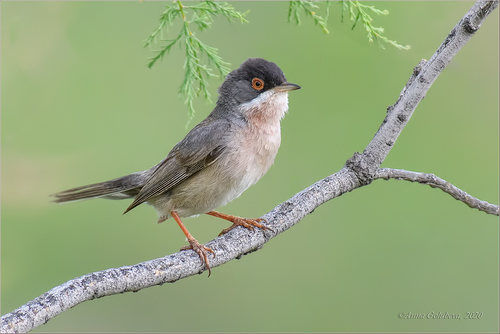
Ménétries's Warbler
Curruca mystacea
A spirited desert voyager, Ménétries's Warbler is famous for its striking white 'moustache' and its energetic, tail-flicking displays in the scrublands of Southwest Asia.
Quick Identification
Size
12–14 cm (4.7–5.5 in) in length; wingspan of 15–19 cm (5.9–7.5 in); weight ranges from 9–11 g (0.3–0.4 oz)
Colors
Males have a dark grey to blackish cap, white moustachial stripe, and pinkish-buff throat/breast. Females are sandy-brown above and pale below.
Key Features
- Dark grey or black cap contrasting with a bright white moustachial stripe
- Pinkish-red wash on the throat and upper breast of males
- Long, active tail often held cocked with white outer feathers
- Reddish-brown eye-ring and pale iris
When You’ll See Them
Geographic range
Where Does the Ménétries's Warbler Live?
This species is primarily native to Southwest Asia and the Middle East. Its core breeding range stretches from eastern Turkey and the Caucasus region through Iraq, Iran, and into Central Asian countries like Turkmenistan and Uzbekistan. As a migratory species, it travels south for the winter, populating the Arabian Peninsula and parts of Northeast Africa, including Sudan and Ethiopia, where it seeks out similar scrubby environments.
Basemap © OpenStreetMap contributors
Behavior
Ménétries's Warbler is a restless and active little bird, typical of the Curruca genus. It spends much of its time skulking within dense scrub or low-lying vegetation, moving with quick, jerky motions as it hunts for food. Despite its secretive nature, it is frequently seen because of its habit of cocking and flicking its tail, often fanning it to reveal white outer feathers. During the breeding season, males become more conspicuous, singing from the tops of bushes or performing short song-flights to defend their territory.
In its interactions with humans, this species is generally wary but can become quite accustomed to backyard gardens in Southwest Asia, especially if there is a reliable water source. They are primarily solitary outside of the breeding season but may join loose mixed-species flocks during migration. Their song is a fast, chattering warble, somewhat harsher than the related Sardinian Warbler, often interspersed with mimicry of other birds.
EverydayEarth exclusive
Camera Tips
To capture the Ménétries's Warbler on camera, placement is everything. These birds are low-level foragers, so your AI-powered camera should be mounted no higher than 2 to 3 feet off the ground. Aim the lens toward the edge of dense thickets or scrubby bushes where the birds naturally dart in and out for cover. If you have a bird bath or a small dripping water feature, this is your best bet for a clear shot, as these warblers are highly attracted to water in their typically arid environments.
Because they are incredibly fast-moving, use a camera setting with a high trigger speed and a short recovery time. If your camera allows for it, a burst mode is ideal to catch the moment they fan their tails or flare their throat feathers. Ensure the camera is positioned to avoid direct midday sun, which can wash out the subtle pink tones on the male's breast; early morning light provides the best color accuracy for this species.
In a backyard setting, planting native shrubs like Tamarisk or dense, thorny hedges will encourage them to linger. They are less likely to visit traditional seed feeders, so focusing your camera on water sources or insect-rich flowering plants is a much more effective strategy. During the spring migration, keep an eye out for the males singing from exposed perches, which provides a rare opportunity for a still, unobstructed photo.
Similar Species
Species that look similar or are commonly confused with Ménétries's Warbler.
Frequently Asked Questions
Record Ménétries's Warbler at your habitat
Connect a camera to start building your own species record — AI identifies every visitor automatically.