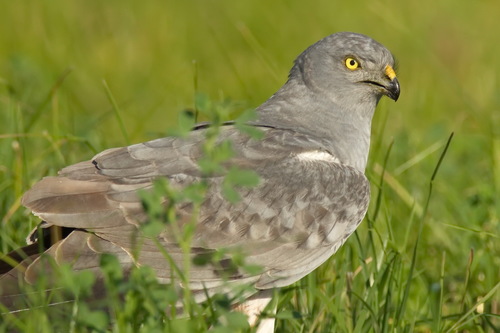
Montagu's Harrier
Circus pygargus
The Montagu's Harrier is an elegant, long-winged specialist of the open plains, famous for its 'sky-dancing' displays and incredible migratory journeys spanning continents.
Quick Identification
Size
Length: 39–50 cm (15–20 in); Wingspan: 102–123 cm (40–48 in); Weight: 230–445 g (8–16 oz)
Colors
Males are pale bluish-grey with black wingtips and a distinct black bar on the upper wing. Females and juveniles are mottled brown with a white rump patch.
Key Features
- Slender, long-winged silhouette with a buoyant, 'V-shaped' flight
- Male has a single black wing-bar and chestnut streaks on the flanks
- Female has a narrow white rump and a dark bar on the secondaries
- Smaller and more delicate than the similar Hen Harrier
When You’ll See Them
Geographic range
Where Does the Montagu's Harrier Live?
The Montagu's Harrier is a cosmopolitan traveler of the Old World, breeding across a vast expanse of the Palearctic from Western Europe and North Africa through Central Asia to the Russian Far East. As a strictly migratory bird, it vacates its breeding grounds in late summer to spend the winter months in the tropical savannahs of Sub-Saharan Africa and across the Indian subcontinent. While its presence is widespread, it is often localized, favoring areas with traditional, low-intensity farming or expansive natural grasslands.
Basemap © OpenStreetMap contributors
Behavior
During the breeding season, males perform spectacular aerial displays known as 'sky-dancing,' which involve steep climbs followed by tumbling nose-dives to impress females. They are ground-nesters, typically hiding their eggs in thick vegetation or cereal crops, a habit that makes them vulnerable to modern harvesting machinery. Despite their wide migration, they are relatively shy and avoid heavily forested or urbanized areas.
EverydayEarth exclusive
Camera Tips
Focus on 'pinch points' in the landscape. These harriers often follow natural linear features like hedgerows, drainage ditches, or the transition zone between a crop field and a wild meadow. Placing your camera at the corner of a field where two different vegetation types meet increases your chances of catching a low-flying hunter. Because they are daytime hunters, ensure your camera has a fast trigger speed and a high-quality sensor to handle the bright, direct sunlight of open fields without washing out the delicate grey plumage of the male.
Avoid using food baits, as harriers are specialized hunters of live prey and are rarely attracted to carrion. Instead, look for their favored 'perching' spots. In a flat landscape, a single prominent hay bale, a low gate, or a large rock can be a magnet for a harrier looking to preen or scan the area. Seasonal timing is everything: in Europe, set your cameras in May and June when the birds are most active defending territories and feeding young. Use a wide-angle setting if possible, as their 1-meter wingspan can easily fill a frame even at a distance.
Similar Species
Species that look similar or are commonly confused with Montagu's Harrier.
Frequently Asked Questions
Record Montagu's Harrier at your habitat
Connect a camera to start building your own species record — AI identifies every visitor automatically.