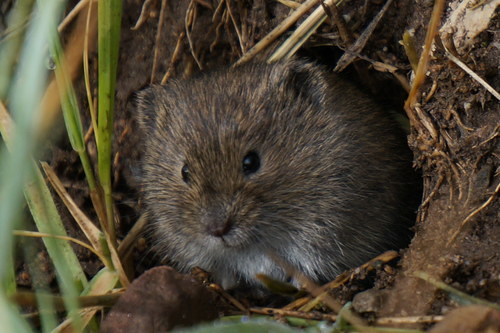
Montane Vole
Microtus montanus
The Montane Vole is the tiny, tireless tunnel-maker of the West, thriving in rugged mountain meadows and surviving harsh winters under the snow.
Quick Identification
Size
Total length: 140-195 mm (5.5-7.7 in); Weight: 30-85 g (1.1-3 oz)
Colors
Upperparts are grizzled brownish-gray to sepia; underparts are silvery-white to light gray; tail is distinctly bicolored.
Key Features
- Stocky body with a tail less than one-third its total length
- Small ears that are almost entirely hidden by thick fur
- Grizzled 'salt and pepper' fur texture
- Bicolored tail, darker on top and lighter on bottom
When You’ll See Them
Geographic range
Where Does the Montane Vole Live?
Native to the mountainous regions of western North America, the Montane Vole is a quintessential high-country resident. Its core range spans the western United States and southwestern Canada, stretching from the interior of British Columbia southward through the Rocky Mountains, the Great Basin, and into the Sierra Nevada and Cascade ranges. These hardy rodents are found in states ranging from Washington and Montana down to New Mexico and California, wherever moist, grassy habitat exists at mid-to-high elevations.
Basemap © OpenStreetMap contributors
Behavior
Montane Voles are the industrious architects of the western high country. They are best known for creating 'runways'—deliberate, narrow paths clipped through dense grass that connect their burrow entrances to feeding sites. These paths act as high-speed highways, allowing them to zip between cover while remaining hidden from the keen eyes of hawks and owls. Unlike many mountain residents, they do not hibernate; instead, they spend their winters in the 'subnivium'—the narrow gap between the ground and the bottom of the snowpack—where they remain active and protected from the freezing wind.
These rodents are semi-fossorial, meaning they spend a significant amount of time underground in shallow burrow systems. Their populations are famously cyclical, often exploding in numbers every three to four years, which provides a massive food source for local predators. While they are generally solitary and can be territorial during the breeding season, their high reproductive rate ensures they are one of the most numerous mammals in their range.
EverydayEarth exclusive
Camera Tips
To successfully capture a Montane Vole on camera, you must first locate their 'runway' networks. These are 1-2 inch wide paths in tall grass where the vegetation has been flattened or chewed away to the soil. Place your camera only 3-5 inches off the ground, pointing directly along one of these paths. Because voles are small and fast, use a camera with a high trigger speed (0.2s or faster) and set it to take 3-photo bursts to ensure you catch more than just a blurry tail.
In a backyard setting, focus on the edges of garden beds or near woodpiles and rock walls. These transition zones provide the cover voles crave. To encourage them to linger for the AI to identify them, place a small amount of 'bait' like birdseed or a smear of peanut butter on a flat rock in the center of the frame. This will force them to pause their frantic scurrying for a clear shot.
Seasonality plays a big role in vole spotting. During the spring melt, look for 'snow tunnels'—tubes of mud and dead grass left behind on the surface as the snow disappears. Placing a camera near these exposed tunnels can yield high traffic. At night, ensure your camera's infrared LEDs are clean; the reflective quality of their fur can sometimes cause 'white-out' on close-range night shots, so try to angle the camera at a 45-degree angle to the path rather than head-on.
Similar Species
Species that look similar or are commonly confused with Montane Vole.
Frequently Asked Questions
Record Montane Vole at your habitat
Connect a camera to start building your own species record — AI identifies every visitor automatically.