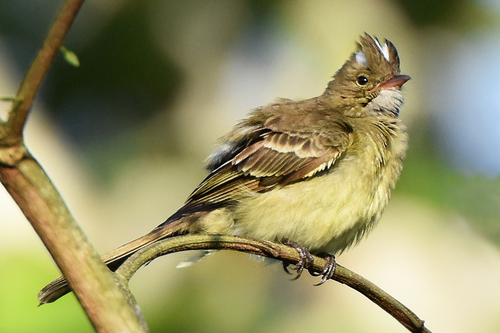
Mottle-backed Elaenia
Elaenia gigas
A spirited resident of the Andean foothills, the Mottle-backed Elaenia is a master of the forest edge. With its distinctive scaly plumage and energetic crest-raising, it is a favorite for backyard birders across South America.
Quick Identification
Size
Length: 18-19 cm (7-7.5 inches); Weight: 25-32g (0.9-1.1 oz)
Colors
Dusky olive-brown upperparts with pale feather edges (mottling); pale yellow to white belly; grayish throat; two distinct white wing bars.
Key Features
- Distinctive mottled or 'scaly' appearance on the back feathers
- Prominent bushy crest often revealing a white center
- Two bold white wing bars on dark wings
- Relatively large size for a flycatcher in its genus
When You’ll See Them
Geographic range
Where Does the Mottle-backed Elaenia Live?
The Mottle-backed Elaenia is a South American specialist, primarily found along the eastern slopes of the Andes. Its range extends from southern Colombia through Ecuador and Peru, reaching its southernmost points in northern and central Bolivia. It is a characteristic bird of the lush 'Piedmont' region, where the mountains meet the Amazonian lowlands.
Basemap © OpenStreetMap contributors
Behavior
The Mottle-backed Elaenia is a conspicuous and vocal member of the tyrant flycatcher family. Unlike many of its more reclusive relatives, this bird is known for perching boldly on exposed branches or atop shrubs along forest edges. It is a highly active species, frequently raising its messy crest and flicking its wings while scanning the environment for its next meal. Its presence is often signaled by its loud, burry vocalizations, which are a common sound in the Andean foothills.
Socially, they are usually found alone or in pairs. While they are territorial during the breeding season, they are generally tolerant of human presence and can become a regular fixture in gardens and clearings that offer a mix of dense cover and open perching spots. Their movement is characterized by short, sudden 'sallies' to catch insects in mid-air or quick hover-gleaning to snatch berries from tropical shrubs.
EverydayEarth exclusive
Camera Tips
To capture high-quality footage of the Mottle-backed Elaenia, place your camera near the 'edge' zones of your property. Look for areas where dense bushes transition into open lawns or paths. These birds prefer perching on horizontal, unobstructed branches roughly 5 to 10 feet off the ground, which give them a clear view for hunting. Position your camera at eye level with these branches for the best profile shots.
Using a camera with a high-speed trigger is essential. Because the Mottle-backed Elaenia is a flycatcher, its movements are rapid and erratic. Setting your AI camera to 'Video' mode with a 15-second duration is often more rewarding than still photos, as it will likely capture the bird's characteristic crest-raising or the 'mottled' back patterns as it turns. Ensure the camera is positioned to avoid direct backlight, which can wash out the subtle feather details needed for identification.
Attracting this species to your lens is best done through habitat rather than traditional feeders. They are highly attracted to native berry-producing shrubs like Miconia. If you have these in your yard, aim your camera at the fruiting clusters. Additionally, a shallow, elevated birdbath in a semi-shaded area can be a magnet for them during the hotter parts of the day, providing excellent opportunities for 'bath-time' captures.
Pay attention to the audio settings if your camera supports it. The Mottle-backed Elaenia is quite vocal, and its calls can help the AI identify the species even before it enters the frame. During the early morning hours, the light is softest, which helps highlight the unique pale edges of their back feathers—the 'mottle' that gives them their name. Avoid using flash if possible, as it can startle them; natural light in the first few hours after dawn is your best friend.
Similar Species
Species that look similar or are commonly confused with Mottle-backed Elaenia.
Frequently Asked Questions
Record Mottle-backed Elaenia at your habitat
Connect a camera to start building your own species record — AI identifies every visitor automatically.