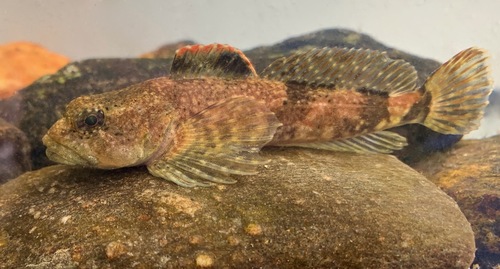
Mottled Sculpin
Cottus bairdii
A master of underwater camouflage, the Mottled Sculpin is a secret sentinel of North America's coldwater streams. This fascinating bottom-dweller 'walks' across riverbeds on oversized fins, hiding in plain sight among the stones.
Quick Identification
Size
3 to 5 inches (7.6 to 12.7 cm) in length; typically weighs less than 1 ounce (28 g).
Colors
Camouflaged with mottled patterns of brown, olive, and black; underside is creamy white. Breeding males become much darker, often appearing nearly black.
Key Features
- Large, fan-shaped pectoral fins used for anchoring to rocks
- Broad, flattened head with upward-looking eyes
- No swim bladder, causing a characteristic 'hopping' movement
- Scaleless skin with a slimy texture
When You’ll See Them
Geographic range
Where Does the Mottled Sculpin Live?
The Mottled Sculpin is native to the North American continent, where it maintains a broad but somewhat patchy distribution. Its core range stretches from the Great Lakes and the Mississippi River basin in the United States up into southern Canada, with distinct populations also found along the Appalachian Mountains as far south as Georgia. It is also found in the western United States, particularly within the Columbia and Missouri River drainages, where it thrives in cold, well-oxygenated headwater streams.
Basemap © OpenStreetMap contributors
Behavior
The Mottled Sculpin is a master of disguise and a dedicated bottom-dweller. Lacking a swim bladder—the organ most fish use for buoyancy—it is heavier than water and spends its life resting on the substrate. Instead of graceful swimming, it moves in short, frantic bursts or 'hops' across the stream bed, using its oversized pectoral fins to wedge itself against rocks in fast-moving currents.
They are highly territorial and solitary predators. A single sculpin will often claim a specific flat rock as its home base, defending the cavity beneath it from intruders. While they appear lethargic, they are lightning-fast ambush hunters, lunging at passing larvae or small crustaceans with surprising speed before retreating back into the shadows of the riverbed.
EverydayEarth exclusive
Camera Tips
Capturing a Mottled Sculpin requires an underwater camera setup, such as a waterproof action camera or a specialized submersible trail cam. Because these fish live strictly on the bottom, the camera must be positioned at the 'fish-eye level.' Look for a shallow riffle or the downstream side of a large, flat rock in a clear creek. Secure your camera to a heavy diving weight or a flat brick to keep it from shifting in the current, and point the lens toward a small patch of gravel or the entrance to a rocky crevice.
Since sculpins are crepuscular, timing is everything. Set your camera to record during the twilight hours of early morning or late evening. If your device has infrared (IR) capabilities, utilize them for nighttime monitoring, as sculpins often emerge from deep cover under the safety of darkness. Avoid using bright white LEDs, which can wash out the details of their intricate camouflage and startle the fish.
To increase your chances of a close-up, you can try a 'natural lure' strategy. Gently disturb the rocks and silt about three feet upstream of your camera placement. This releases aquatic insects and larvae into the drift, which often triggers a feeding response in nearby sculpins, drawing them directly into your camera's field of view. Be sure to check the water clarity after rain, as turbid water will result in poor footage; wait for a period of dry weather when the stream runs clear.
Similar Species
Species that look similar or are commonly confused with Mottled Sculpin.
Frequently Asked Questions
Record Mottled Sculpin at your habitat
Connect a camera to start building your own species record — AI identifies every visitor automatically.