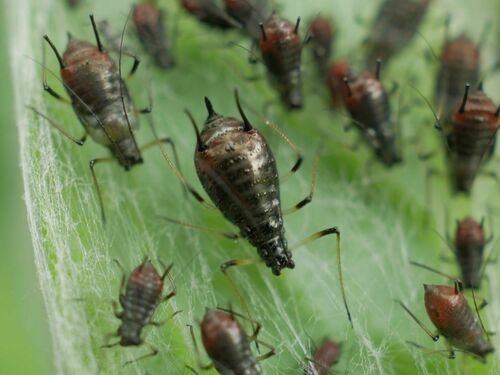
Mountain Cornflower Aphid
Uroleucon montanivorum
A high-altitude specialist of the Rocky Mountains, the Mountain Cornflower Aphid is a master of survival in rugged meadows. These shiny, bronze-colored insects form complex miniature societies on the stems of wild cornflowers.
Quick Identification
Size
2.5–4.0 mm (0.1–0.16 inches) in length
Colors
Dark reddish-brown to bronze-black with a polished, shiny appearance; legs and antennae often show pale segments with dark joints.
Key Features
- Large, spindle-shaped body typical of the genus Uroleucon
- Exceedingly long, dark siphunculi (tail pipes)
- High-altitude specialist found primarily on Centaurea species
- Long, slender legs that give it a 'leggy' appearance
When You’ll See Them
Geographic range
Where Does the Mountain Cornflower Aphid Live?
Native to the mountainous regions of North America, the Mountain Cornflower Aphid is most commonly found throughout the Rocky Mountain range. Its distribution stretches from the Canadian Rockies in Alberta and British Columbia southward through the high-elevation corridors of Montana, Wyoming, and Colorado. While primarily a wilderness species, it can also be found in high-altitude suburban gardens where native or ornamental cornflowers are cultivated.
Basemap © OpenStreetMap contributors
Behavior
The Mountain Cornflower Aphid is a specialist feeder that forms dense colonies on the stems and flower heads of cornflowers (Centaurea species). Like many members of its genus, it is relatively active for an aphid, though it spends most of its time with its piercing mouthparts inserted into the plant's phloem to drink nutrient-rich sap. These aphids are often found in a head-down orientation on the upper third of the host plant.
These insects participate in complex ecological relationships. They are frequently tended by mountain-dwelling ant species, which protect the aphids from predators in exchange for honeydew—a sugary waste product the aphids excrete. When threatened by a predator like a ladybug or lacewing larva, these aphids may perform a synchronized 'kicking' or 'dropping' maneuver to escape the plant foliage.
EverydayEarth exclusive
Camera Tips
Capturing the Mountain Cornflower Aphid requires a specialized macro setup, as these insects are too small for standard trail cameras. For the best results, use an AI-powered camera with a dedicated macro lens or a close-focusing attachment. Position your camera approximately 4 to 6 inches from the flower stalks of Centaurea plants. Because even a light mountain breeze can move the plant out of focus, try to secure the host plant to a garden stake or choose a location sheltered from the wind.
Lighting is critical for documenting this species. The dark, metallic body of the aphid can easily appear as a black smudge in poor light. Aim for bright, diffused daylight—early morning or late afternoon provides the best 'golden hour' light that highlights the bronze sheen of their cuticle without the harsh glare of midday sun. If your camera allows, use a high shutter speed to freeze any movement caused by the wind or the aphids' own shifting.
To increase your chances of a sighting, look for 'indicator' species. Ants crawling up and down a cornflower stalk are a primary sign that a colony of Mountain Cornflower Aphids is nearby. Set your camera to trigger on small movements or use time-lapse mode with short intervals (e.g., one photo every 30 seconds) during peak daylight hours. This will allow you to capture not just the aphids, but also the fascinating interactions with their ant guardians and potential predators like hoverfly larvae.
Similar Species
Species that look similar or are commonly confused with Mountain Cornflower Aphid.
Frequently Asked Questions
Record Mountain Cornflower Aphid at your habitat
Connect a camera to start building your own species record — AI identifies every visitor automatically.