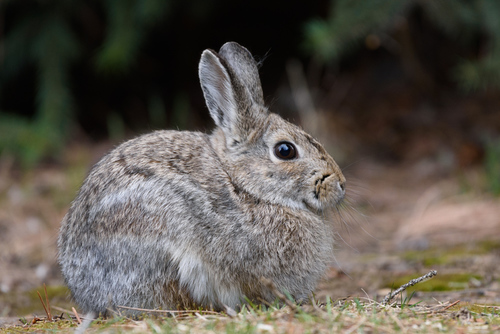
Mountain Cottontail
Sylvilagus nuttallii
A hardy survivor of the western high country, the Mountain Cottontail is easily recognized by its rusty-colored legs and nervous, high-speed energy. Often found at the edge of the forest, this shy mammal is a favorite for backyard observers in the Rockies and Cascades.
Quick Identification
Size
Length: 33-39 cm (13-15.3 in); Weight: 0.7-1.2 kg (1.5-2.6 lbs)
Colors
Pale grayish-brown upper body with a distinct orange or rusty-colored nape (back of neck) and legs; creamy white underside and a fluffy white tail.
Key Features
- Large black-tipped ears with dense inner fur
- Distinctive rusty-orange patch on the nape and hind legs
- Short, rounded ears compared to desert species
- Large, fluffy white 'cotton' tail
When You’ll See Them
Geographic range
Where Does the Mountain Cottontail Live?
The Mountain Cottontail is a quintessential resident of the North American West. Its native range spans from the southern interior of British Columbia and Alberta in Canada, down through the Great Basin and Rocky Mountain states, reaching as far south as New Mexico and Arizona. It is specifically adapted to the varied elevations of the Cascade, Sierra Nevada, and Rocky Mountain ranges, making it the most common rabbit found in high-altitude western woodlands.
Basemap © OpenStreetMap contributors
Behavior
Mountain Cottontails are masters of the 'freeze and blend' tactic. Unlike their more boisterous jackrabbit cousins, these rabbits prefer to stay close to dense cover like sagebrush, thickets, or rock crevices. When startled, they typically make a short, zig-zagging dash toward the nearest dense vegetation rather than a long-distance sprint, relying on their camouflage to disappear into the shadows.
These rabbits are primarily crepuscular, meaning they are most active during the low-light hours of dawn and dusk. During the heat of the day, they rest in 'forms'—shallow depressions in the ground hidden under low-hanging branches or within rock piles. While they are generally solitary, you may see multiple individuals foraging in the same meadow where food is particularly abundant, though they maintain a respectful distance from one another.
EverydayEarth exclusive
Camera Tips
To capture the elusive Mountain Cottontail, placement is everything. These rabbits rarely venture more than a few feet from 'escape cover.' Position your camera low to the ground—about 6 to 10 inches high—aimed at the edge where a lawn or clearing meets dense brush, sagebrush, or a rock pile. This 'edge habitat' is their preferred foraging zone. Angle the camera slightly downward to ensure you catch their small profile without it being triggered by swaying branches above.
Because they are most active during twilight, ensure your camera has a high-quality infrared (IR) flash. This allows you to get clear black-and-white night shots without scaring them off with a bright white light. Fast trigger speeds are essential; even a 'slow' rabbit moves quickly when it senses a predator. Setting your camera to 'Burst Mode' is a great way to see their characteristic hopping behavior and ear movements, which are often missed in single photos.
In the winter, Mountain Cottontails are often drawn to the base of fruit trees or woody shrubs where they nibble on bark. If you live in an arid region, a low-profile water feature or birdbath at ground level is a powerful magnet for these thirsty travelers. During the spring, look for 'runways'—faint paths in the grass—and place your camera along these routes to catch them on their daily commute between their daytime hiding spots and evening feeding grounds.
Similar Species
Species that look similar or are commonly confused with Mountain Cottontail.
Desert Cottontail
Has much longer ears with less fur inside and is typically found in hotter, lower-elevation desert scrub.
Snowshoe Hare
Much larger hind feet and turns completely white in the winter, whereas the Mountain Cottontail stays gray-brown.
Eastern Cottontail
Lacks the distinct black-tipped ears and has a larger, more prominent white blaze on the forehead (often absent in Mountain Cottontails).
Frequently Asked Questions
Record Mountain Cottontail at your habitat
Connect a camera to start building your own species record — AI identifies every visitor automatically.