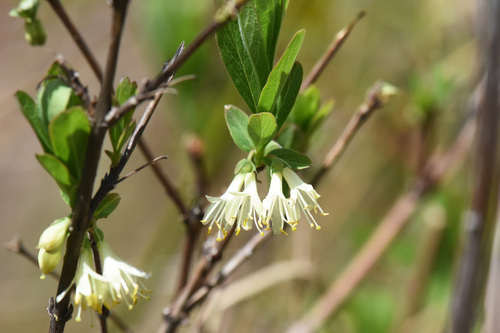
mountain fly-honeysuckle
Lonicera villosa
A hidden gem of North American wetlands, the mountain fly-honeysuckle offers more than just beauty. Its velvety leaves and early summer berries provide a vital sanctuary and feast for pollinators and songbirds alike.
Quick Identification
Size
A low-growing shrub typically reaching 30–90 cm (1–3 ft) in height with a similar spread.
Colors
Dull green leaves with velvety hairs; pale yellow to white funnel-shaped flowers; dusty blue berries with a waxy bloom.
Key Features
- Pairs of yellowish-white funnel flowers
- Elliptic leaves with fine, velvety hairs (villous)
- Edible blue berries that resemble elongated blueberries
- Low, multi-stemmed shrubby growth habit
When You’ll See Them
Behavior
Mountain fly-honeysuckle is a hardy, deciduous shrub that plays a vital role in wetland and woodland ecosystems. Unlike its aggressive, invasive cousins, this native North American species grows slowly and lives in harmony with surrounding flora. It is one of the first shrubs to leaf out in the spring, providing an early source of cover for ground-nesting birds and small mammals moving through damp meadows or bog edges.
During its blooming phase in late spring, it becomes a hub of activity for early-season pollinators. The nectar-rich, paired flowers are specifically shaped to accommodate long-tongued bees and butterflies. As the season progresses into mid-summer, the plant shifts its energy into producing nutrient-dense blue fruits. Because it thrives in acidic, moist soils where other fruiting plants might struggle, it is a dependable food source for wildlife during the transition from breeding to migration seasons.
EverydayEarth exclusive
Camera Tips
To capture the true magic of the mountain fly-honeysuckle, you aren't just filming a plant—you are filming the ecosystem it supports. Set your camera on a time-lapse setting during the late spring (May to June) to capture the delicate opening of its twin flowers. Because this shrub is low to the ground, use a ground-stake mount or a low tripod. Position the lens about 12-18 inches from a healthy cluster of buds to document the transition from flower to fruit over several weeks.
If you are looking for wildlife action, the fruiting stage in July is your best bet. Position your camera at a slight downward angle, roughly 2 feet from the ground, focusing on a branch heavy with blue berries. This height is perfect for capturing visiting Cedar Waxwings, Catbirds, or even small rodents like voles and chipmunks that feast on the fallen fruit. Use a high-trigger speed setting (0.2s to 0.5s) because these visitors tend to be quick and skittish.
Lighting can be tricky in the damp, shaded areas where this honeysuckle thrives. If your camera is under a thick forest canopy, increase your ISO sensitivity or ensure the lens is directed toward a sun-dappled opening. For the most vibrant colors, try to capture the berries in the early morning light (6-8 AM), which highlights the waxy 'bloom' on the blue skin, making them pop against the green foliage.
For those interested in insects, use a camera with a macro-focus capability or a close-up lens attachment. The mountain fly-honeysuckle is a favorite of the rare early-season bumblebees. By focusing on the throat of the flower and using a high-frame-rate video setting (60fps or higher), you can capture the intricate 'tongue' movements of bees as they navigate the nectar spurs, providing incredible educational footage for your backyard gallery.
Similar Species
Species that look similar or are commonly confused with mountain fly-honeysuckle.
Frequently Asked Questions
Record mountain fly-honeysuckle at your habitat
Connect a camera to start building your own species record — AI identifies every visitor automatically.