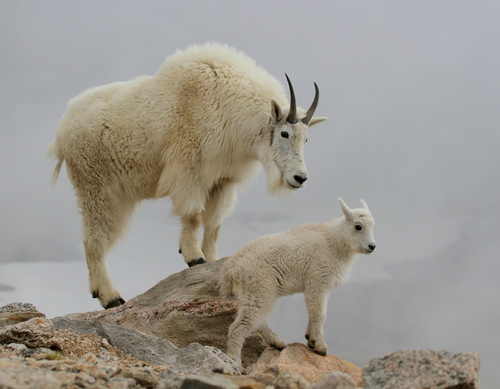
Mountain Goat
Oreamnos americanus
Meet the ultimate high-altitude specialist. With gravity-defying hooves and a thick, snow-white coat, the Mountain Goat thrives where few other creatures dare to tread.
Quick Identification
Size
Length: 120-180 cm (4-6 ft); Shoulder Height: 90-120 cm (3-4 ft); Weight: 45-140 kg (100-310 lbs)
Colors
Stark white to cream-colored shaggy coat; contrasting black horns, eyes, and hooves
Key Features
- Permanent, slender black horns with annual growth rings
- Shaggy white double coat with a distinctive 'beard' on the chin
- Distinctive shoulder hump and muscular build for climbing vertical terrain
When You’ll See Them
Geographic range
Where Does the Mountain Goat Live?
Native to the rugged mountain ranges of western North America, the Mountain Goat's domain stretches from the sub-arctic peaks of south-central Alaska and the Yukon down through British Columbia and Alberta. Within the contiguous United States, their core range encompasses the towering heights of the Cascade and Rocky Mountain ranges in Washington, Idaho, and Montana. They have also been successfully introduced to mountainous regions in Colorado, Utah, Nevada, and South Dakota's Black Hills to bolster local biodiversity.
Basemap © OpenStreetMap contributors
Behavior
Mountain Goats are the undisputed masters of the heights, spending their lives on near-vertical cliffs that would terrify most other mammals. They are highly social but hierarchical, with females (nannies) typically dominating the social structure and leading small bands of kids. Males (billies) are often more solitary for much of the year, joining groups primarily during the fall rut.
These animals are generally wary of humans but can become habituated in high-traffic hiking areas. Because their environment is nutrient-poor, they are famously obsessed with salt. They will travel miles to reach natural salt licks and have been known to approach campsites specifically to lick salt residues from gear or soil, a behavior that requires cautious management by hikers to avoid dangerous encounters.
EverydayEarth exclusive
Camera Tips
Capturing the elusive Mountain Goat requires a strategic approach focused on 'pinch points' and mineral sources. Because these animals are bound to steep terrain, look for established goat trails—narrow paths worn into the scree or dirt along ridgelines or at the base of cliffs. Position your camera at a height of about 3 to 4 feet, angled slightly downward if you are on a slope, to account for their stocky profile. High-quality trail cameras with a fast trigger speed are essential, as goats can move surprisingly quickly across technical terrain.
Mineral licks are the 'holy grail' for Mountain Goat photography. In the early summer, goats often descend to specific locations to replenish salts lost during the winter. If you find a natural salt lick or a rocky outcropping where goats have been seen bedding down, place your camera 10-15 feet away. Avoid using artificial bait, as this can disrupt their natural behavior and lead to habituation; instead, focus on natural attractants like prominent 'lookout' rocks where billies often stand to survey their territory.
Lighting is your biggest challenge due to their brilliant white coats. In the harsh midday sun, white fur often 'blows out' or overexposes on digital sensors. Set your camera to a lower exposure bias if possible, or position it so it faces north or south to avoid direct sunrise/sunset glare. The best shots often occur during the 'golden hours' of dawn and dusk when the low-angle light brings out the texture of their shaggy wool. During the winter, ensure your camera is equipped with lithium batteries to withstand the sub-zero temperatures of their high-altitude home.
Similar Species
Species that look similar or are commonly confused with Mountain Goat.
Frequently Asked Questions
Record Mountain Goat at your habitat
Connect a camera to start building your own species record — AI identifies every visitor automatically.