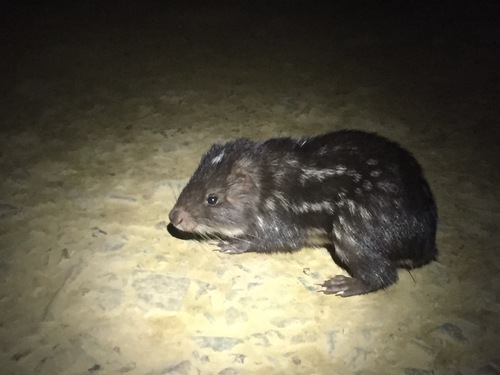
Mountain Paca
Cuniculus taczanowskii
Meet the 'spotted phantom' of the high Andes. The Mountain Paca is a secretive, fruit-loving rodent that navigates the misty cloud forests of South America under the cover of darkness.
Quick Identification
Size
Length 47–77 cm (18.5–30 in); Weight 6–12 kg (13–26.5 lb)
Colors
Dark reddish-brown to chocolate brown upperparts with four to five rows of distinct white spots along each flank; pale cream or white underbelly.
Key Features
- Robust, heavy-set body with short legs
- Prominent white spots arranged in horizontal lines along the sides
- Large head with uniquely swollen cheekbones (zygomatic arches)
- Coarser, denser fur compared to its lowland cousins
When You’ll See Them
Geographic range
Where Does the Mountain Paca Live?
The Mountain Paca is a high-altitude specialist native to the rugged landscapes of South America. Its distribution is strictly tied to the Andean mountain chain, where it thrives in the misty, cool environments of the cloud forests and montane woodlands. This species is found across a core range that stretches from the northern heights of Venezuela and Colombia, down through the mountain backbones of Ecuador and Peru, reaching its southern limits in the highlands of Bolivia. Unlike its lowland relatives, it is never found in the hot tropical basins, preferring elevations where the air is thin and the vegetation is lush and damp.
Basemap © OpenStreetMap contributors
Behavior
The Mountain Paca is a shy, enigmatic resident of the high Andes. Primarily nocturnal, these rodents spend their nights foraging through the dense undergrowth and their days resting in deep burrows or rocky crevices. They are highly territorial and solitary, usually only coming together to mate. One of their most fascinating traits is the use of their enlarged, hollow cheekbones as resonating chambers, allowing them to produce loud, growling barks or tooth-grinding sounds to warn off intruders or communicate across the foggy forest floor.
In the wild, they are creatures of habit, often using well-beaten paths through the vegetation to travel between their burrows and favorite feeding spots. While they are generally wary of humans, their sedentary nature means that once a paca establishes a territory near a rural homestead or forest edge, it is likely to remain in that specific area for years. They are excellent swimmers and will often take to the water if they feel threatened by a predator.
EverydayEarth exclusive
Camera Tips
To capture a Mountain Paca on camera, focus your efforts on 'high-traffic' game trails within cloud forest environments. These rodents are creatures of habit and will often use the same narrow paths through the moss and ferns night after night. Look for areas near small streams or boggy patches, as they prefer to stay close to water. Position your camera low to the ground—about 12 to 18 inches high—angled slightly upward to capture their spotting patterns and facial features clearly.
Because the Mountain Paca lives in extremely humid, high-altitude environments, lens fogging and moisture damage are significant risks. Use a high-quality weather-sealed camera housing and consider placing a few silica gel desiccant packs inside the battery compartment. Since they are strictly nocturnal, a camera with a high-quality 'no-glow' or black IR flash is essential; standard white flashes or even low-glow LEDs can startle these cautious animals, causing them to flee the area and avoid that specific trail in the future.
Baiting can be effective if local regulations allow. Sweet, aromatic fruits like fallen avocados, guavas, or even native highland berries can act as a powerful lure. Place the bait in a small clearing in front of the camera rather than directly on the trail to encourage the paca to pause for a clear, still shot. Set your camera to take 'burst' photos or short 10-second videos, as pacas move with a distinctive stop-and-start gait that can lead to blurry images if the shutter speed is too slow.
Similar Species
Species that look similar or are commonly confused with Mountain Paca.
Frequently Asked Questions
Record Mountain Paca at your habitat
Connect a camera to start building your own species record — AI identifies every visitor automatically.