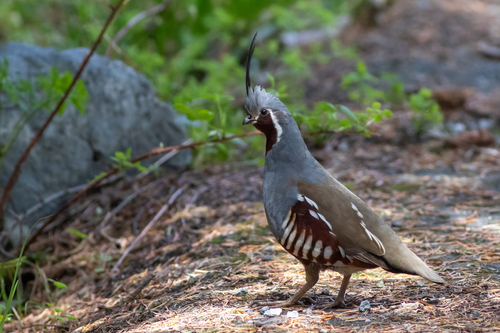
Mountain Quail
Oreortyx pictus
The largest and most secretive quail in North America, the Mountain Quail is a master of the high-altitude brush. With its signature straight plume and striking chestnut throat, this bird is a prize find for any backyard wildlife enthusiast.
Quick Identification
Size
Length: 26–28 cm (10–11 in); Wingspan: 35–40 cm (14–16 in); Weight: 180–360 g (6.3–12.7 oz)
Colors
Slate-gray head and breast; olive-brown back and wings; rich chestnut throat patch with a white border; bold white vertical bars on chestnut flanks.
Key Features
- Two long, straight black head plumes pointing backward
- Chestnut throat patch with a distinct white frame
- Prominent white vertical barring on the flanks
- Gray-blue plumage on the neck and upper chest
When You’ll See Them
Geographic range
Where Does the Mountain Quail Live?
Native to the mountainous regions of western North America, the Mountain Quail thrives along the Pacific Coast and throughout the Sierra Nevada. Its core range extends from the southern tip of British Columbia, Canada, through Washington, Oregon, and California, reaching down into the Baja California peninsula of Mexico. While they are occasionally found in parts of Idaho and Nevada, they remain most abundant in the steep, shrubby highlands of the Pacific mountain chains.
Basemap © OpenStreetMap contributors
Behavior
Mountain Quail are notably more secretive and reclusive than their California Quail cousins. They prefer to stay under the cover of dense brush and are more often heard than seen, giving away their presence with a loud, echoing 'que-ark' call. Unlike many other birds, they primarily move by walking or running through steep terrain rather than flying, only taking to the air in short, explosive bursts when startled.
These birds are unique for their altitudinal migration; instead of flying south for the winter, they walk down the mountains to lower elevations to avoid heavy snow, then walk back up as the weather warms. They are social birds that live in small family groups called coveys during the winter, though these groups typically break apart during the breeding season when pairs become territorial.
EverydayEarth exclusive
Camera Tips
To capture the elusive Mountain Quail, camera placement is everything. Since these birds are ground-dwellers that prefer thick cover, position your camera no higher than 12-18 inches off the ground. Aim the lens toward the edges of dense brush or 'ecotones' where shrubbery meets a small opening. They rarely venture far into the open, so a camera pointed at a wide, exposed lawn is unlikely to yield results.
Water is the single best attractant for Mountain Quail, especially in the dry summer months. If you have a low-profile birdbath or a natural seep on your property, set your camera to monitor it. They are habitual drinkers and will visit water sources daily. Use a fast trigger speed setting, as their movements can be jerky and quick when they emerge from the shadows to drink.
During the winter, if you are in a region where they descend to lower elevations, providing a ground-level feeding station with cracked corn or high-quality wild bird seed can draw in a whole covey. However, ensure the feeder is near protective cover so the birds feel safe enough to visit. Early morning just after sunrise is the 'golden hour' for Mountain Quail activity; set your AI camera to be most sensitive during these times to capture their beautiful plumage in the best light.
Similar Species
Species that look similar or are commonly confused with Mountain Quail.
Frequently Asked Questions
Record Mountain Quail at your habitat
Connect a camera to start building your own species record — AI identifies every visitor automatically.