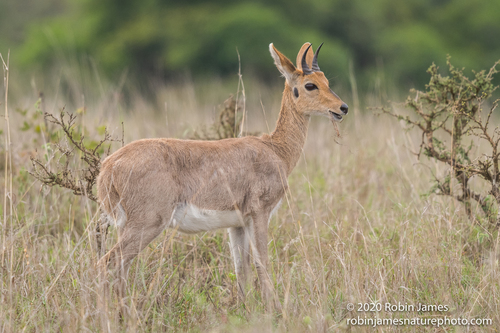
Mountain Reedbuck
Redunca fulvorufula
A master of the high-altitude slopes, the Mountain Reedbuck is a graceful antelope known for its distinctive whistling call and agile movement across rocky terrain. Spotting one of these shy, woolly-coated creatures is a true reward for any backyard naturalist living near the hills.
Quick Identification
Size
Height: 70–80 cm (28–31 in); Weight: 20–35 kg (44–77 lbs); Length: 110–136 cm (43–54 in)
Colors
Greyish-brown or reddish-buff coat with a distinctly white underbelly and tail underside; males have short, black horns
Key Features
- Short, forward-curving horns on males
- Distinctive circular black patch of bare skin below each ear
- Thick, woolly coat texture
- Long, bushy tail with white underside
When You’ll See Them
Geographic range
Where Does the Mountain Reedbuck Live?
The Mountain Reedbuck is native to the African continent, where it exists in three distinct, geographically separated populations. The core range of the southern subspecies is found in the highlands of South Africa, Lesotho, and Eswatini, while the eastern and western populations inhabit the rift valleys of Ethiopia and Kenya, and the Adamawa Plateau of Cameroon and Nigeria. This fragmented distribution highlights their specialization for high-altitude grasslands and rocky slopes across sub-Saharan Africa.
Basemap © OpenStreetMap contributors
Behavior
Mountain Reedbucks are highly social yet shy antelopes that typically live in small family groups consisting of a single dominant male and several females with their young. They are extremely agile on steep, rocky terrain, moving with a characteristic 'rocking-horse' gait when startled. Unlike many other antelopes that flee immediately, the Mountain Reedbuck often relies on its camouflage, standing perfectly still against the backdrop of mountain grasses until it feels the threat is too close.
Communication is vital for their survival in open landscapes. When they sense danger, they emit a sharp, shrill whistle through their nostrils that serves as an alarm for the rest of the herd. They are most active during the cooler parts of the day, spending the hot midday hours resting in the shade of rocks or trees. While they are generally wary of humans, populations living near protected areas or mountainous suburbs can become somewhat accustomed to a quiet human presence.
EverydayEarth exclusive
Camera Tips
To capture the Mountain Reedbuck on a trail camera, focus your placement on north-facing slopes which receive more sunlight and tend to be preferred grazing spots. Because these antelopes are crepuscular, high-quality infrared (IR) or 'no-glow' flash is essential to prevent spooking them during their peak activity hours at dawn and dusk. Mounting your camera at a height of about 0.8 meters (2.5 feet) and angling it slightly upward if positioned on a slope will provide the best framing for their mid-sized build.
Look for well-established 'game trails' that wrap around the contours of hills or lead toward secluded mountain springs and water holes. Mountain Reedbucks are creatures of habit and will often use the same paths daily. If you are setting up in a backyard that borders a nature reserve or mountain park, providing a clean water source or a mineral lick can be an effective lure, though local regulations on wildlife feeding should always be checked first.
Use a fast trigger speed (under 0.5 seconds) and set your camera to take a burst of 3-5 photos per trigger. These animals can move surprisingly fast across uneven ground, and a burst ensures you catch a clear profile shot rather than just a blur of a tail. Avoid placing the camera facing directly into the rising or setting sun, as the lens flare on mountain ridges can wash out images during the very times the Reedbuck is most active.
Similar Species
Species that look similar or are commonly confused with Mountain Reedbuck.
Frequently Asked Questions
Record Mountain Reedbuck at your habitat
Connect a camera to start building your own species record — AI identifies every visitor automatically.