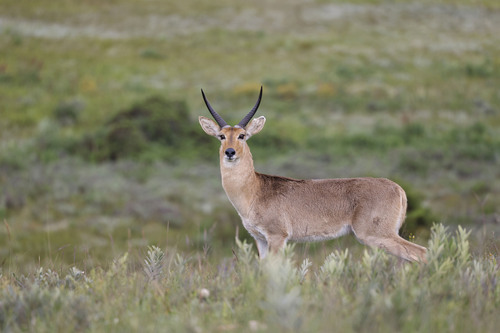
Southern Reedbuck
Redunca arundinum
With its elegant, forward-curving horns and a signature whistling call, the Southern Reedbuck is a master of the wetlands. This graceful antelope is a delight to discover on camera, often found hiding in plain sight among the tall grasses.
Quick Identification
Size
Body length 134–167 cm (53–66 in); weight 50–95 kg (110–210 lb) for males and 30–70 kg (66–154 lb) for females.
Colors
Silky grey-brown to tan coat with a white underside; males possess thick, forward-curving horns and a distinctive black glandular patch under each ear.
Key Features
- Distinctive black circular patch (subauricular gland) below each ear
- Forward-curving, ridged horns present only in males
- Bushy tail with a white underside visible when running
- Dark vertical markings on the front of the forelegs
When You’ll See Them
Behavior
Southern Reedbucks are famously cautious and rely on a 'freeze and flee' strategy. When they sense a predator, they remain perfectly still in tall grass, hoping their tawny coat provides enough camouflage. If the threat gets too close, they suddenly explode into a run, characterized by a unique rocking-horse gait where their hindquarters bounce high into the air, flashing the white underside of their tail as a warning to others.
These antelopes are most often found in pairs or small family units, consisting of a male, female, and their most recent offspring. They are highly territorial and use a sharp, piercing whistle through their nostrils to communicate danger or mark their presence. Unlike many other herd-based species, they are quite sedentary and will stay in the same small home range for most of their lives as long as water remains available.
EverydayEarth exclusive
Camera Tips
To successfully capture Southern Reedbuck on camera, focus your efforts on the edges of 'ecotones'—the transition zones between dense reedbeds and open grazing lawns. These animals use the thick cover for sleeping but move into the open to feed during the early morning and late afternoon. Position your camera approximately 30 inches (75 cm) off the ground and angle it slightly upward to account for their height and the likelihood of them jumping if they are startled by the camera's shutter or IR flash.
Because Southern Reedbucks are water-dependent, placing your camera near a permanent water hole or a well-trodden path leading to a stream is your best bet for high-traffic results. During the dry season, they are particularly predictable in their movements toward water. If you are using an AI-powered camera, set it to record video clips of at least 15 seconds; these antelopes often pause at the edge of cover to scan for predators, providing beautiful, still footage before they begin grazing.
Pay close attention to your trigger speed settings. When the Southern Reedbuck is spooked, it moves with an incredibly fast, bouncing motion that can easily result in a 'ghost' image or an empty frame if your camera isn't fast enough. A trigger speed of 0.3 seconds or faster is recommended. In winter, when the grass turns golden-brown, their camouflage is nearly perfect, so use a 'High' PIR sensitivity setting to ensure the sensor detects the heat signature of the animal against the similarly colored background.
For the most natural behavior, try to conceal the camera using local foliage or a camouflage wrap. While they are curious, they have excellent eyesight and may avoid an area if they spot a bright plastic box attached to a tree. If you are lucky enough to have a 'resident' pair, try not to check the camera too often, as excessive human scent in their small home range might cause them to relocate their preferred sleeping spot further away from your lens.
Similar Species
Species that look similar or are commonly confused with Southern Reedbuck.
Mountain Reedbuck
Smaller in size with a greyish coat; found in rocky hills rather than the wet grasslands preferred by Southern Reedbucks.
Grey Rhebok
Features a much thinner neck and straight, needle-like horns compared to the Southern Reedbuck's curved, ridged horns.
Impala
Lacks the black ear patch and has a distinct black 'M' marking on the rump and black tufts on the back of the ankles.
Frequently Asked Questions
Record Southern Reedbuck at your habitat
Connect a camera to start building your own species record — AI identifies every visitor automatically.