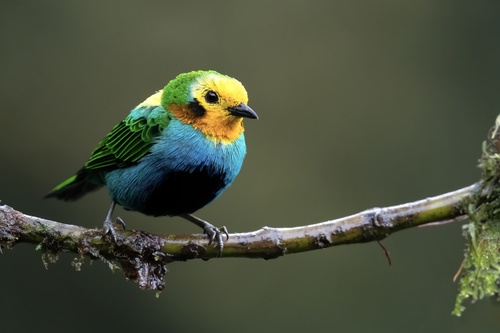
Multicolored Tanager
Chlorochrysa nitidissima
Endemic to the misty cloud forests of Colombia, the Multicolored Tanager is widely considered one of the most beautiful birds in South America. Its vibrant, multi-colored plumage makes it a crown jewel for any backyard observer in its native range.
Quick Identification
Size
12-13 cm (4.7-5.1 inches) in length; approximately 18-22 grams (0.6-0.8 oz)
Colors
A complex palette of bright yellow crown and mantle, emerald green wings, electric blue rump, and orange-chestnut ear patches. The throat and chest center feature a distinctive black patch.
Key Features
- Golden-yellow crown and nape
- Distinctive chestnut-orange patches behind the eyes
- Jet-black throat and belly center
- Vibrant emerald green wings and blue rump
When You’ll See Them
Geographic range
Where Does the Multicolored Tanager Live?
This spectacular bird is a South American treasure found exclusively in the mountains of Colombia. It is a narrow-range endemic, meaning it lives nowhere else on Earth except for the Western and Central Andes. Within this region, it inhabits specific subtropical slopes where the climate remains humid and the forest cover is dense.
Basemap © OpenStreetMap contributors
Behavior
The Multicolored Tanager is an energetic and restless bird that brings a flash of color to the Colombian cloud forests. They are highly social and are rarely seen alone; instead, they usually travel in pairs or join larger mixed-species foraging flocks. Within these flocks, they move quickly through the middle and upper levels of the canopy, often performing acrobatic maneuvers to reach food.
These birds are known for their 'gleaning' foraging style, where they hop along mossy branches to find hidden insects or hang upside down to pluck small berries. While generally shy in the wild, they have become somewhat habituated to ecotourism sites in Colombia, where they may visit fruit feeders alongside other tropical species. Their vocalizations are relatively quiet, consisting of high-pitched, thin 'tsip' notes that blend into the sounds of the misty forest.
EverydayEarth exclusive
Camera Tips
Capturing the Multicolored Tanager requires a camera setup tailored for high-humidity, low-light environments. Because they spend most of their time in the canopy, you will have the best luck placing your AI-powered camera near a forest edge or a known 'hotspot' like a fruiting Miconia tree. If you are on a property with a bird feeding station, position the camera at eye level with the feeder, roughly 3 to 5 feet away, to capture the intricate details of their multi-hued plumage.
Baiting with native fruits like bananas or papayas is the most effective way to draw them down from the high canopy. When setting up your camera, prioritize a fast shutter speed or a high-sensitivity motion sensor; these birds are incredibly twitchy and rarely stay still for more than a second or two. A 'burst' or 'multi-shot' setting is essential to ensure you get at least one clear frame between their rapid hops.
Be mindful of the morning fog common in the Colombian Andes, which can obscure your lens. Using a camera with a protective housing and a small lens hood can help prevent condensation. The best lighting occurs during the 'golden hours' of early morning when the sun hits the upper slopes, as this light brings out the iridescence in their emerald wings and blue rump that might otherwise look dark in deep shade.
Similar Species
Species that look similar or are commonly confused with Multicolored Tanager.
Frequently Asked Questions
Record Multicolored Tanager at your habitat
Connect a camera to start building your own species record — AI identifies every visitor automatically.