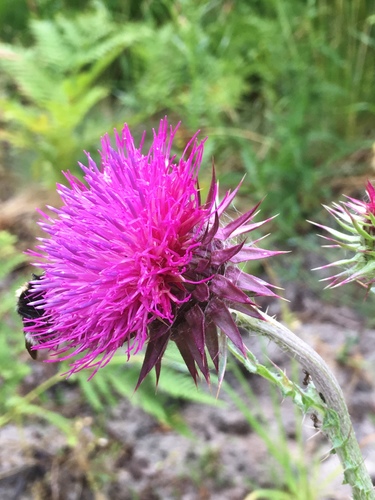
musk thistle
Carduus nutans
Recognized by its dramatic drooping purple blooms and formidable spiny armor, the Musk Thistle is a master of survival. Though a stubborn invader, it serves as a bustling nectar station for your neighborhood's most beautiful butterflies and songbirds.
Quick Identification
Size
Height ranges from 0.5 to 2 meters (1.5 to 6.5 feet); flower heads are typically 3 to 7 cm (1 to 3 inches) in diameter.
Colors
Brilliant pink to deep purple flower heads; stems are grey-green; leaves are dark green with prominent silver-white margins and midribs.
Key Features
- Distinctive 'nodding' flower head that droops at a 90-degree angle
- Spiny, winged stems that leaf out all the way to the flower
- Broad, solitary purple bloom with pinecone-like bracts beneath
- Deeply lobed, prickly foliage with a silver-white edge
When You’ll See Them
Behavior
The musk thistle is a biennial plant, meaning it completes its life cycle over two years. In its first year, it exists as a low-growing rosette of leaves, hugging the ground to survive the winter. During the second year, the plant 'bolts,' sending up a tall, multi-branched stalk topped with its signature drooping purple flowers. It is famously prolific, with a single healthy plant capable of producing up to 20,000 seeds that are easily dispersed by the wind using feather-like bristles.
While humans often view it as a noxious weed due to its invasive nature in North America and its ability to crowd out native forage, it plays a complex role in the ecosystem. Its flowers produce copious amounts of nectar, making it a primary destination for bees, butterflies, and other pollinators. However, because its sharp spines deter livestock and most wildlife from grazing on it, it can quickly take over a pasture or backyard if left unchecked.
EverydayEarth exclusive
Camera Tips
Capturing the musk thistle on a trail camera offers a unique opportunity to document the 'hidden' life of a backyard pollinator hub. To get the best shots, mount your camera on a small stake about 12 to 24 inches off the ground, angled slightly upward. This 'worm's eye view' emphasizes the dramatic 'nodding' head of the flower against the sky and allows you to capture the intricate detail of the spiny stems. If your camera has a macro or close-focus setting, use it to highlight the geometric patterns of the bracts beneath the flower head.
Because musk thistles are magnets for wildlife, don't just focus on the plant itself—treat it as a stage. Position your camera to capture the visitors. During the day, set a high-speed trigger or short video mode to catch butterflies like the Painted Lady or various bumblebee species. In the late summer, goldfinches are frequently seen perched directly on the flower heads to pluck out the seeds; a camera placed 3-5 feet away with a clear line of sight will capture these colorful birds in action.
If you have a camera with time-lapse capabilities, the musk thistle is an ideal subject. Set the camera to take a photo every 30 minutes during the 'bolting' phase in late spring to watch the stalk shoot up toward the sun. Alternatively, a time-lapse of the flower opening and eventually turning into a 'puffball' of white seeds provides a fascinating look at the plant's reproductive cycle. Make sure to secure the camera firmly, as these plants often grow in windy, open areas where motion blur can be an issue.
For the most striking 'hero' shots, utilize the golden hour. The fine, silvery hairs on the thistle's stem and the translucent purple petals catch the low-angled light of sunrise or sunset beautifully. If your backyard camera has an adjustable LED or flash, try diffusing it with a piece of semi-transparent tape to avoid overexposing the white-rimmed leaves, which can be highly reflective at night.
Similar Species
Species that look similar or are commonly confused with musk thistle.
Frequently Asked Questions
Record musk thistle at your habitat
Connect a camera to start building your own species record — AI identifies every visitor automatically.