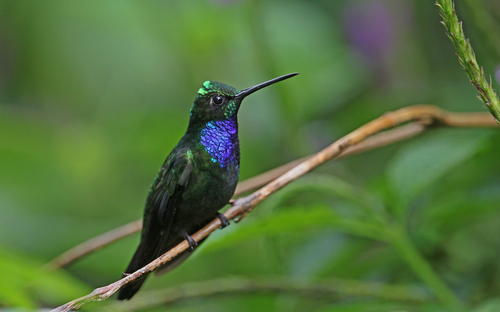
Napo Sabrewing
Campylopterus villaviscensio
A rare gem of the Andean foothills, the Napo Sabrewing captivates with its brilliant violet crown and majestic, powerful flight. This Near Threatened hummingbird is a prize find for any backyard observer on the eastern slopes of the Andes.
Quick Identification
Size
12-13.5 cm (4.7-5.3 in) in length; weighing approximately 8-9 grams (0.28-0.32 oz)
Colors
Deep iridescent green body; males feature a brilliant violet-blue crown and throat; females have greyish-white underparts with green spotting on the flanks.
Key Features
- Large, robust hummingbird silhouette
- Iridescent violet-blue crown and throat (males)
- Slightly decurved black bill
- Prominent white spot behind the eye
- Broad, rounded tail with dark feathers
When You’ll See Them
Geographic range
Where Does the Napo Sabrewing Live?
The Napo Sabrewing is a specialist of the South American Andes, specifically the lush eastern slopes. Its native range is a narrow corridor stretching from southern Colombia through eastern Ecuador and into the northern reaches of Peru. This species thrives in the high-moisture 'cloud forest' belt where flowering plants are plentiful throughout the year.
Basemap © OpenStreetMap contributors
Behavior
In the wild, they are generally solitary but can be found in loose proximity where food is abundant. They are relatively bold and will continue feeding even if a camera or human is nearby, provided they don't feel directly threatened. During the breeding season, males may perform aerial displays to attract mates, though their nesting habits remain elusive and rarely observed near human settlements.
EverydayEarth exclusive
Camera Tips
Because this species is a heavy-set hummingbird, it prefers sturdy perches near its feeding sites. Placing a thin, horizontal branch roughly 12 inches from a feeder can encourage the bird to land, providing a much clearer image than a hovering shot. Set your camera height between 4 and 5 feet to align with the mid-story flowering plants they prefer. If your camera allows for shutter speed adjustment, aim for 1/2000th of a second or faster to freeze their wing motion.
Lighting is crucial for this species; the violet-blue crown only 'pops' in direct or bright filtered light. Try to angle the camera so the morning sun is behind the lens. In the humid Andean environment, lens fogging is a major issue. Use an anti-fog spray on the external lens housing and ensure the camera is in a well-ventilated spot to minimize condensation during the misty mornings when these birds are most active.
Similar Species
Species that look similar or are commonly confused with Napo Sabrewing.
Frequently Asked Questions
Record Napo Sabrewing at your habitat
Connect a camera to start building your own species record — AI identifies every visitor automatically.