Violet Sabrewing
Campylopterus hemileucurus
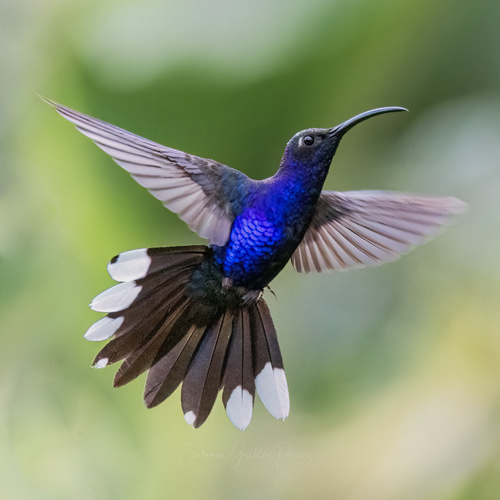
The Violet Sabrewing is the undisputed heavyweight of the hummingbird world in Central America. With its shimmering purple plumage and commanding presence, it is a spectacular visitor to any highland garden or cloud forest edge.
Quick Identification
Size
13–15 cm (5–6 in) long; wingspan approx 18 cm (7 in); weight 9–12 g (0.32–0.42 oz)
Colors
Males are deep violet-purple on the head and underparts with dark green backs; females are metallic green above and grey below with a violet throat patch. Both have prominent white outer tail corners.
Key Features
- Largest hummingbird in its range
- Deep iridescent violet-purple plumage (males)
- Broad, curved black bill
- Large white spots on the corners of the tail
When You’ll See Them
Geographic range
Where Does the Violet Sabrewing Live?
The Violet Sabrewing is native to the mountainous regions of southern North America and Central America. Its range begins in the highlands of southern Mexico, extending through the cloud forests of Guatemala, Honduras, and Nicaragua, reaching its highest densities in the mid-elevation forests of Costa Rica and western Panama. These birds are specialized for moist, high-altitude environments where they serve as essential pollinators for native tropical flora.
Basemap © OpenStreetMap contributors
Behavior
These birds are 'trapliners,' meaning they follow a routine route between widely spaced flowers rather than staying in one patch all day. Males are often found in 'leks' during the breeding season, where several individuals gather in the understory to sing a repetitive, metallic chipping song to attract females. Despite their forest origins, they are relatively bold around humans if nectar is provided.
EverydayEarth exclusive
Camera Tips
To capture the Violet Sabrewing on a backyard or trail camera, focus on high-speed trigger settings. Because of their size and speed, they can easily blur if the shutter isn't fast enough. Position your camera near large, brightly colored tubular flowers—red and orange are their favorites. Heliconia or Canna lilies are perfect natural lures. Aim the camera at a height of 4 to 5 feet, as these birds often forage in the mid-canopy but will descend to this level for nectar.
Lighting is the most critical factor for capturing the Sabrewing’s iridescence. To see the brilliant violet shimmer, the camera should be positioned so the sun is behind the lens, illuminating the bird's chest and head directly. If the lighting is too flat or coming from behind the bird, the plumage will appear almost black. Use a high-definition video setting if possible, as the movement of their wings and the shifting colors are more impressive than a still photo.
If using a hummingbird feeder as a lure, select one with a sturdy perch. Because Violet Sabrewings are heavy compared to other species, they prefer to sit while they drink rather than hovering constantly. Set your camera's 'detection zone' specifically around the feeder port to avoid false triggers from wind-blown leaves. Early morning, just after sunrise, is the peak time for activity, as these birds are among the first to feed as the forest wakes up.
Similar Species
Species that look similar or are commonly confused with Violet Sabrewing.
Frequently Asked Questions
Record Violet Sabrewing at your habitat
Connect a camera to start building your own species record — AI identifies every visitor automatically.