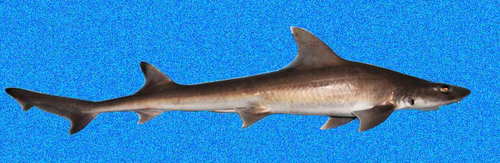
Narrowfin Smooth-hound
Mustelus norrisi
A sleek and slender specialist of the Atlantic shelf, the Narrowfin Smooth-hound is a harmless 'houndshark' known for its distinctive pointed snout and graceful bottom-cruising behavior.
Quick Identification
Size
Length up to 1.1 m (3.6 ft); typically weighs between 2.3-5.5 kg (5-12 lbs)
Colors
Uniform grey to greyish-brown on the upper body with a pale, off-white underside; lacks the white spots seen on some other smooth-hound species
Key Features
- Long, narrow snout tapering to a rounded point
- Slender, elongated body with two large dorsal fins
- Smooth skin texture due to very fine dermal denticles
- Blunt, molar-like teeth adapted for crushing shells
- Large spiracles located directly behind the eyes
When You’ll See Them
Geographic range
Where Does the Narrowfin Smooth-hound Live?
The Narrowfin Smooth-hound is native to the subtropical and tropical coastal waters of the Western Atlantic Ocean. Its primary range begins in the United States along the coasts of Florida and extends through the northern Gulf of Mexico down to Venezuela. A separate, distinct population is also found further south along the coast of southern Brazil, making it a true American endemic of the continental shelf.
Basemap © OpenStreetMap contributors
Behavior
The Narrowfin Smooth-hound is a sophisticated bottom-dweller that spends its life navigating the sandy and muddy expanses of the continental shelf. As a member of the 'houndshark' family, it is known for its relatively social nature, often traveling in loose groups rather than remaining solitary. These sharks are entirely harmless to humans, possessing a shy temperament that typically leads them to swim away when approached by divers.
Foraging is the primary driver of their behavior, and they are most active during the nocturnal and crepuscular hours. They use their specialized snouts to probe the sediment for hidden prey. Unlike the apex predators of the open ocean, these sharks are built for the 'crunch,' using their powerful jaws and flat, grinding teeth to process hard-shelled invertebrates. They are viviparous, meaning they give birth to live young, usually in shallow nursery areas where the pups are protected from larger predators.
EverydayEarth exclusive
Camera Tips
Capturing the Narrowfin Smooth-hound on camera requires a specialized underwater setup, typically mounted to a dock piling or a weighted seafloor tripod. For coastal 'backyard' observers with canal or beach access, the best placement is 1 to 2 feet above the seabed in a clearing between seagrass patches. Angling the camera slightly downward ensures you capture the shark's distinctive narrow snout and ground-hugging swimming style.
Scent is the most effective lure for this species. Using a 'chum pod'—a perforated PVC pipe or mesh bag filled with crushed crabs or oily fish like sardines—will create a scent trail that these sharks can follow from a significant distance. Secure the lure about 3 feet in front of the lens to ensure the shark enters the frame and pauses long enough for a clear identification.
Since these sharks are most active at night, your camera must have strong infrared (IR) or low-glow LED capabilities. Standard white light can be abrasive and may cause the shark to bank away quickly. If using a motion-triggered trail camera in an underwater housing, set the trigger interval to the shortest possible time, as these sharks often cruise by in a steady, continuous motion without stopping.
Water clarity is your biggest challenge in the shallow coastal areas this shark prefers. Aim to check your camera after a period of calm weather and incoming tides, which bring in clearer oceanic water. Set your camera to record in high definition with a frame rate of at least 60fps; this allows you to slow down the footage to observe the fine details of their skin and the specific shape of their dorsal fins, which are key for distinguishing them from other smooth-hounds.
Similar Species
Species that look similar or are commonly confused with Narrowfin Smooth-hound.
Frequently Asked Questions
Record Narrowfin Smooth-hound at your habitat
Connect a camera to start building your own species record — AI identifies every visitor automatically.