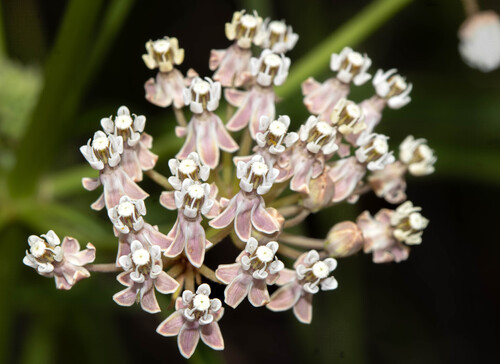
narrowleaf milkweed
Asclepias fascicularis
The narrowleaf milkweed is a vital sanctuary for Monarch butterflies and a stunning addition to any drought-tolerant garden. Its delicate whorled foliage and star-shaped blooms transform backyard spaces into thriving pollinator hubs.
Quick Identification
Size
Grows 1 to 3 feet (30–90 cm) tall with leaves 3 to 5 inches (8–12 cm) long.
Colors
Lavender, pale pink, or greenish-white flowers; narrow green to grayish-green foliage.
Key Features
- Narrow, needle-like leaves arranged in whorls along the stem
- Dense clusters of star-shaped flowers with five reflected petals
- Slender, upright green stems that exude white milky sap
- Pointed seed pods (follicles) that release silky-tufted seeds
When You’ll See Them
Geographic range
Where Does the narrowleaf milkweed Live?
Narrowleaf milkweed is native to North America, specifically concentrated across the western United States and northern Mexico. Its core range spans from Washington and Idaho southward through Oregon and throughout nearly every county in California, extending eastward into the arid regions of Nevada and Utah. It is one of the most widespread and adaptable milkweed species in the West, comfortably inhabiting both wild chaparral and developed suburban landscapes.
Basemap © OpenStreetMap contributors
Behavior
Narrowleaf milkweed is a hardy perennial herb that serves as a cornerstone of western North American ecosystems. Unlike many other milkweeds, it is exceptionally drought-tolerant and thrives in dry, sunny conditions. During the spring and summer, it produces dense umbels of flowers that emit a light, sweet fragrance, acting as a magnet for a diverse array of pollinators. As the season progresses, the plant produces long, slender seed pods that eventually burst, releasing silky, wind-dispersed seeds.
This species is most famous for its role as a critical host plant for the Monarch butterfly. Female Monarchs seek out these specific leaves to lay their eggs, and the resulting caterpillars feed exclusively on the foliage, sequestering the plant's toxic cardiac glycosides to become unpalatable to predators. Beyond butterflies, it supports a micro-community of aphids, milkweed bugs, and predatory wasps, making it a bustling hub of activity in any backyard garden.
EverydayEarth exclusive
Camera Tips
To capture the dynamic life surrounding narrowleaf milkweed, position your camera on a tripod or garden stake about 12 to 24 inches from the flower clusters. Since the most interesting action involves butterflies and small insects, use a camera with macro capabilities or a high-resolution sensor that allows for digital zooming. Angle the lens slightly upward to catch the underside of leaves where Monarchs frequently lay eggs and caterpillars hide from the sun.
Time of day is crucial for getting the best footage. Pollinators like bees and butterflies are most active during the warmest hours, typically between 10 AM and 3 PM. To avoid blown-out highlights on the pale flowers, try to diffuse harsh midday sun or set your camera to trigger during the 'golden hour' in late afternoon when the light is softer but the insects are still moving. High-speed shutter settings are recommended to freeze the rapid movement of visiting butterflies or clear shots of buzzing hoverflies.
Don't just focus on the flowers; the stems and the undersides of the narrow leaves are where the drama of the life cycle happens. Consider setting your camera to time-lapse mode over several days during the mid-summer. This can capture the incredible growth of Monarch caterpillars or the slow, dramatic opening of the seed pods. If your camera is AI-powered, ensure it is set to detect 'Insects' or 'Small Animals' to filter out movement from wind-blown leaves while still catching the delicate arrival of a butterfly.
Similar Species
Species that look similar or are commonly confused with narrowleaf milkweed.
Frequently Asked Questions
Record narrowleaf milkweed at your habitat
Connect a camera to start building your own species record — AI identifies every visitor automatically.