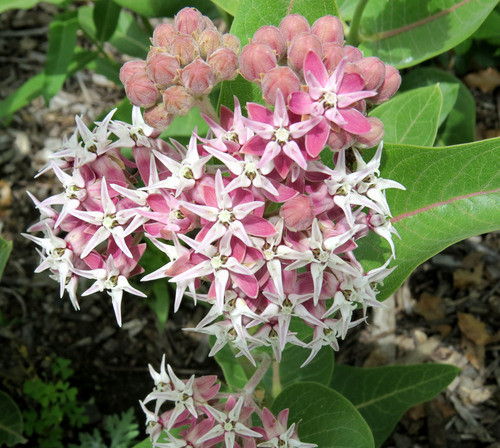
showy milkweed
Asclepias speciosa
The crown jewel of the western prairie, showy milkweed is more than just a wildflower—it's a vital nursery for Monarch butterflies and a stunning architectural centerpiece for any wildlife-friendly backyard.
Quick Identification
Size
Stands 2 to 4 feet (60 to 120 cm) tall with leaves 4 to 7 inches (10 to 18 cm) long.
Colors
Soft sage-green velvety foliage with intricate, star-shaped flowers in shades of pale pink, lavender, and dusty rose.
Key Features
- Distinctive star-shaped petals with long, pointed hoods
- Opposite, oval-shaped leaves with a thick, velvety texture
- Spherical flower clusters called umbels that can reach 4 inches across
- Teardrop-shaped seed pods covered in soft, warty bumps
When You’ll See Them
Geographic range
Where Does the showy milkweed Live?
Showy milkweed is a resilient native of North America, primarily occupying the vast landscapes of the western half of the continent. Its core range extends from the southern provinces of central Canada down through the Great Plains and westward to the Pacific Coast, covering nearly every state in the Western United States. While it thrives in the mountain west and arid basins, it is also a frequent sight in the fertile valleys of California and the damp edges of Midwestern grasslands.
Basemap © OpenStreetMap contributors
Behavior
Showy milkweed is a hardy, colony-forming perennial that thrives in the sun, spreading through both wind-dispersed seeds and a vigorous underground network of rhizomes. Unlike many other garden plants, it produces a thick, latex-like sap rich in cardenolides, which serves as a potent chemical defense against most herbivores. It is often the last to emerge in the spring garden, but its rapid mid-summer growth provides essential structural cover for ground-dwelling wildlife.
As a biological cornerstone of the western prairie, this plant acts as a social hub for the insect world. It is most famous for its symbiotic relationship with the Monarch butterfly, serving as a primary host where females deposit eggs and larvae feed exclusively. Beyond Monarchs, its high nectar production attracts a diverse community of specialized milkweed bugs, predatory wasps, and long-tongued bees, making it a bustling center of ecological interaction from dawn until dusk.
EverydayEarth exclusive
Camera Tips
To capture the true architectural beauty of showy milkweed, position your camera on a low tripod or ground mount to align the lens with the flower clusters, which typically sit 2 to 3 feet above the soil. Using a macro lens or a camera with a dedicated close-focusing mode is essential for documenting the intricate, star-like geometry of the individual blooms. Aim for a side-profile angle to showcase the unique 'horns' and 'hoods' of the flowers, which are the plant's most identifying feature.
Because showy milkweed is a primary destination for Monarch butterflies, setting your camera to a high shutter speed or a high-frame-rate video mode is crucial for freezing the movement of wings. If you are using an AI-powered camera, set it to 'motion trigger' during the peak heat of the day (11 AM to 3 PM) when butterfly and bee activity is at its most frantic. For the most professional look, utilize the 'golden hour' light—the soft, low-angled sun of late afternoon will illuminate the tiny silver hairs on the leaves and stems, creating a glowing 'rim light' effect that makes the plant pop against its background.
Don't turn your cameras off once the flowers fade in late summer. The transition to seed production offers spectacular time-lapse opportunities. Position your camera to face the large, warty pods (follicles) as they dry out. By taking one photo every hour, you can create a stunning sequence of the pod splitting open to reveal hundreds of seeds, each equipped with a parasol of silky white hairs (pappus) designed to catch the wind. Ensure your camera mount is extremely stable, as the tall, heavy stalks can sway in the breeze, which may lead to unwanted motion triggers or blurry frames.
Similar Species
Species that look similar or are commonly confused with showy milkweed.
Frequently Asked Questions
Record showy milkweed at your habitat
Connect a camera to start building your own species record — AI identifies every visitor automatically.