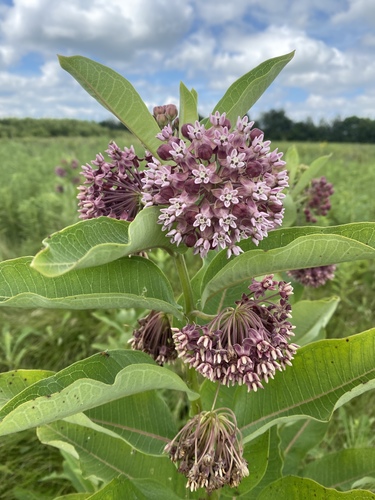
common milkweed
Asclepias syriaca
The ultimate sanctuary for Monarch butterflies, the common milkweed is a resilient beauty that transforms any backyard into a bustling pollinator hub. Known for its intoxicating scent and silky seeds, it is a cornerstone of North American biodiversity.
Quick Identification
Size
Height ranges from 0.9 to 1.5 meters (3 to 5 feet); individual flowers are 1-2 cm (0.4-0.8 inches) wide
Colors
Large green leaves with reddish-purple midribs; flowers are clusters of dusty rose, mauve, or pale pink; seed pods are grey-green
Key Features
- Broad, thick oval leaves arranged in opposite pairs
- Sturdy, unbranched stems that bleed white 'milk' when broken
- Globe-like clusters of drooping, fragrant pink flowers
- Large, teardrop-shaped seed pods with soft prickly bumps
When You’ll See Them
Geographic range
Where Does the common milkweed Live?
Common milkweed is a quintessential North American species, native to the vast landscapes east of the Rocky Mountains. Its territory stretches from the southern provinces of Canada, including Saskatchewan and Quebec, down through the central and eastern United States to the Gulf Coast. While it avoids the arid deserts of the West, it thrives in almost any sunny patch of disturbed soil across the Midwest and Atlantic regions.
Basemap © OpenStreetMap contributors
Behavior
Common milkweed is a perennial powerhouse known for its aggressive growth and vital ecological role. Unlike many garden plants, it spreads through an extensive underground rhizome system, often forming dense colonies or 'clones' in sunny fields and roadsides. During the day, it is a hub of activity as it produces copious amounts of nectar, attracting a dizzying array of pollinators from bumblebees to the iconic Monarch butterfly.
As the season progresses, the plant undergoes a dramatic transformation. After pollination, it develops large, warty follicles (seed pods). In late autumn, these pods dry and split open to reveal hundreds of flat brown seeds, each attached to a tuft of silky white hairs called coma. These 'silks' catch the wind, allowing the species to colonize new areas through wind dispersal, sometimes traveling miles from the parent plant.
EverydayEarth exclusive
Camera Tips
To capture the best of common milkweed, set your camera to a time-lapse mode rather than a motion-trigger mode if you want to record its growth. Position your camera on a stake at a height of about 3 feet (1 meter), angled slightly downward toward the flower clusters. This height is perfect for capturing both the blooming process and the visiting pollinators like Monarchs and Swallowtails that frequent the plant during the heat of the day.
For those interested in the 'micro-fauna' of the backyard, use a camera with a macro lens or a close-focusing distance. Common milkweed is a miniature ecosystem; by focusing on the undersides of the leaves, you can catch the rare footage of Monarch butterflies laying pinhead-sized eggs or the brightly colored yellow-and-black Monarch caterpillars devouring the foliage. Ensure your camera is positioned to the south of the plant to make the most of the backlighting through the leaves, which makes the caterpillars easier to spot.
In the autumn, adjust your camera to face the mature seed pods. If you have a high-speed trigger or a consistent time-lapse, you can capture the 'explosion' of the pods as they burst. High-contrast settings are recommended here to capture the shimmer of the white silk as it catches the light. Because milkweed stays stationary, it is the perfect subject for testing AI-recognition settings for different insect species that land on it.
Similar Species
Species that look similar or are commonly confused with common milkweed.
Frequently Asked Questions
Record common milkweed at your habitat
Connect a camera to start building your own species record — AI identifies every visitor automatically.